
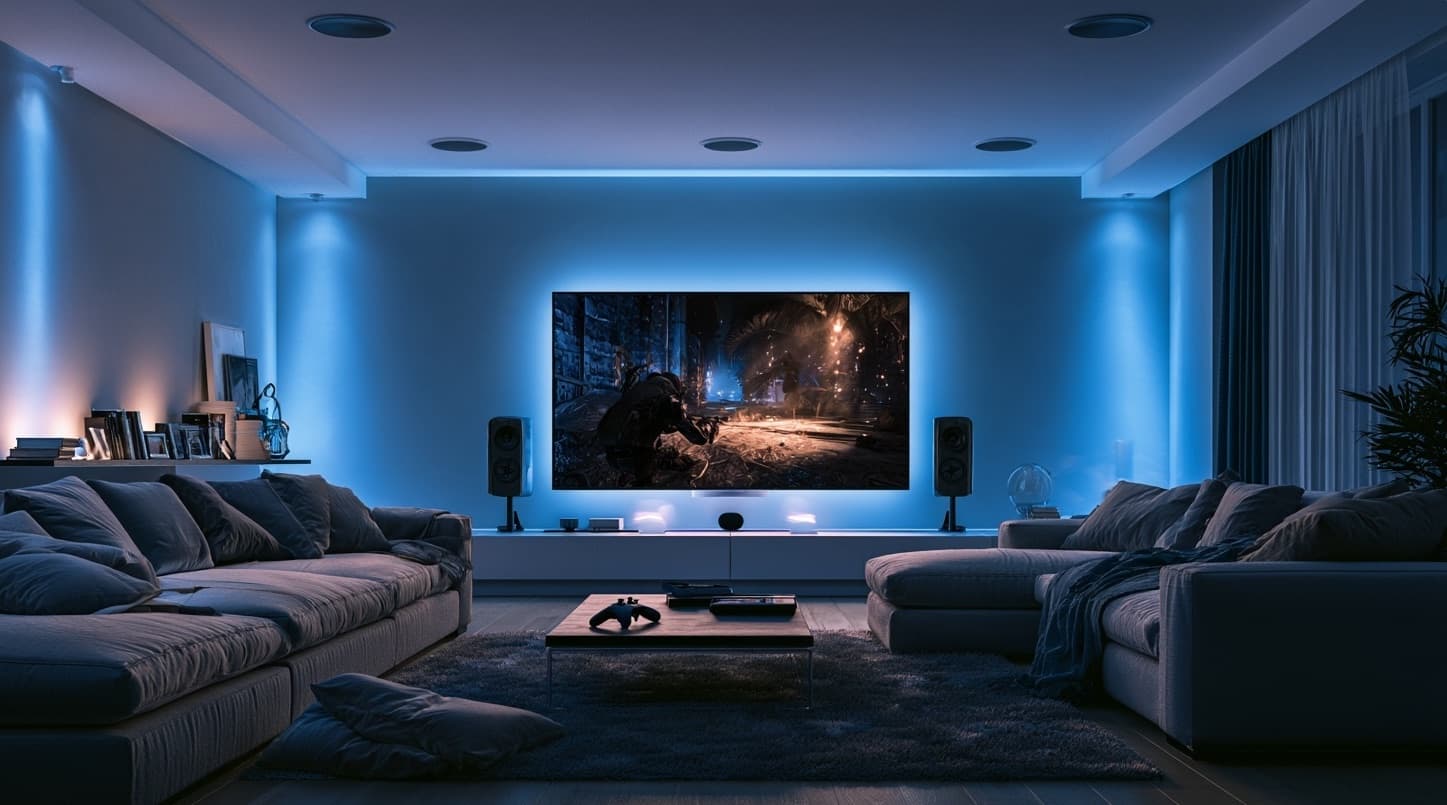
The Dolby Atmos logo shows up everywhere now: on console settings menus, streaming apps, and half the soundbar boxes at any electronics store. Plenty of people switch it on, sit down to play or watch, and hear nothing coming from above. The setting isn't broken. Atmos depends far less on a menu option than on where the speakers sit in the room.
Getting real overhead sound means speakers in or near the ceiling, wire hidden in the walls and a receiver tuned to the room, which is why Atmos is less a product you buy and more a sound system installation you plan around the space you have. Done right, it changes how games and films feel. Done halfway, it sounds like regular surround with a fancier label.
This guide covers what Atmos adds, where the content comes from, which speaker layout fits which room, what happens during installation and calibration, and when a DIY setup stops making sense.
What Dolby Atmos Actually Adds
Traditional surround sound works in channels. A sound gets sent to the front left speaker, the rear right, and so on, and everything happens on one flat level around your ears.
Atmos treats sounds as objects placed in three-dimensional space, height included. The system figures out which speakers should reproduce each object based on how many you have and where they are. A helicopter doesn't just pan from left to right; it passes overhead. Rain lands on the roof above you instead of somewhere off to the side.
You'll see layouts written as 5.1.2 or 7.1.4. The first number counts the speakers around you at ear level, the second the subwoofers, and the third the height speakers. That last number is what separates Atmos from older surround.
For games, the height layer matters more than people expect. Footsteps on the floor above, a drone hovering over a rooftop, a sniper on a balcony: these are moments where knowing that a sound is above you, not just in front, changes what you do next.
Where Atmos Content Comes From Today
There's more Atmos content than ever, but each source needs its own chain of equipment to deliver it. Knowing where it comes from helps you avoid buying gear that can't pass the signal along.
Consoles and PC
Xbox Series X and Series S have supported Atmos in games for years, enabled through Dolby's Access app on the console. PlayStation 5 started out supporting Atmos for movie discs only, and a later system update brought it to games as well, rendered through Sony's own 3D audio engine. On Windows PCs, Atmos for home theater systems is set up through the same Dolby app. Support still varies from title to title, so check a game's audio settings rather than assuming every release takes full advantage.
Movies and Streaming
Most major streaming services carry Atmos soundtracks on a large share of their newer films and series, usually on their higher subscription tiers. 4K Blu-ray discs remain the best-quality source, since they carry the full, less compressed version of the soundtrack.
The Hardware Chain
Between the console and the speakers sits a chain: the source device, the TV, the receiver and the speakers themselves. The receiver needs to decode Atmos, and if the signal travels through the TV, the TV and receiver should connect over HDMI eARC, which carries the full-quality version of the soundtrack. One weak link anywhere in that chain, such as an older receiver or a basic HDMI port, and the system quietly falls back to standard surround or plain stereo.
Choosing a Speaker Layout for Your Room
The right layout depends on the size of the room, the ceiling and where people sit. There's no single best setup, only the one that fits your space.
5.1.2 or 7.1.4
A 5.1.2 layout, with two height speakers, works well in smaller rooms with a single row of seating close to the screen. A 7.1.4 layout adds side surrounds and two more height speakers, which helps larger rooms and setups where people sit farther back, because overhead sounds can move from front to rear instead of hanging in one spot.
In-Ceiling, Wall-Mounted or Upfiring Speakers
There are three ways to get sound from above. In-ceiling speakers give the cleanest result and disappear visually, but they require cutting into the ceiling. Wall-mounted height speakers sit high on the front and back walls and suit rooms where the ceiling can't be opened. Upfiring modules sit on top of the front speakers and bounce sound off the ceiling; they're the easiest option for renters, but they need a flat, hard ceiling of moderate height to work, and the effect is less precise than real overhead speakers.
Seating and the Gaming Spot
Gamers often sit closer to the screen than movie watchers, sometimes in a single chair rather than on a sofa. Height speakers should be aimed at the main seat, so a room built for both gaming and films usually needs a compromise position that works for each, rather than speakers placed for one and ignored by the other.
What the Installation Process Looks Like
This is the part most product reviews skip. A proper Atmos setup involves planning, wiring, mounting and setting up the equipment, and each step affects how the finished system sounds.
Planning and Room Assessment
It starts with measuring the room and choosing speaker positions relative to the main seats. Then comes the less glamorous work: checking what's inside the ceiling. Joists, ductwork, recessed lights and sprinkler lines all limit where speakers can go, and in some buildings they rule out in-ceiling speakers entirely. This is the stage where the layout gets locked in.
Running Wire Through Walls and Ceilings
Speaker cable running along baseboards and across the floor is the clearest sign of a rushed setup. A clean installation routes wire through the walls and ceiling to each speaker, back to a single equipment location. In apartments and older buildings, this takes more planning, since concrete slabs, shared ceilings and building rules can all limit what's possible.
Mounting and Aiming the Speakers
Height speakers need to point toward the listening position, not straight down at the floor. Angled in-ceiling models or adjustable mounts help here. A speaker placed wherever was easiest to reach often sounds detached from the action on screen, as if the sound is coming from a light fixture rather than the game.
The Equipment Rack
The receiver produces heat and needs airflow, so a closed cabinet without ventilation is a poor home for it. It also helps to keep the console, streaming box and receiver in one place, with room to reach the ports, so you're not pulling furniture away from the wall every time you add a device.
Calibration Is Where It All Comes Together
Even well-placed speakers need tuning. Most Atmos receivers include a room-correction system that uses a measurement microphone placed at the listening position to adjust levels, distances and equalization for each speaker. It's a strong starting point, not the final word.
Manual checks follow: confirming that every speaker plays at a matched level, that the subwoofer blends smoothly with the rest of the system, and that the height speakers are actually active. A surprising number of setups sit silent overhead because Atmos was never switched on at the source. On Xbox, that means selecting Atmos through the Dolby app; on PS5, choosing it as the preferred audio format in the sound settings.
The last check is by ear. Play a scene you know well, whether a storm sequence in a film or a firefight in a game with plenty of vertical action, and listen for sounds moving smoothly across and above you.
The Room Still Has the Final Say
Speakers and electronics are only half the system. Bare walls, hardwood floors and large windows bounce sound around the room, blurring the precise placement Atmos is built for. A thick rug, heavy curtains and some sound-absorbing panels at the side walls go a long way toward keeping overhead effects sharp.
Apartment dwellers face a second issue. Ceiling speakers and a subwoofer push sound into the building's structure, and late-night gaming sessions reach neighbors faster than you'd think. Planning for that before installation is far easier than fixing it after a complaint.
DIY Setup or Professional Installation
Some Atmos setups are well within reach for a weekend project. A soundbar with upfiring modules, or floor-standing speakers with Atmos add-on modules on top, can be set up with basic tools and the receiver's automatic calibration.
In-ceiling speakers, wiring hidden inside walls, and a room that has to work for both gaming and films are a different job. Teams such as New York Soundproofing handle both the audio and the acoustics side, designing, installing and calibrating systems for rooms across New York City and running video consultations for people planning a setup elsewhere. Whichever way you go, you'll know the system is right the first time a helicopter actually passes over your head.

Nick Guli
Nick Guli is the founder and editor-in-chief of Explosion.com, which he launched in February 2012. With over a decade of experience in digital publishing, Nick oversees editorial direction across entertainment, gaming, technology, and lifestyle content. He is an avid gamer and movie enthusiast who brings a critical eye to coverage of industry trends, game reviews, and entertainment news.