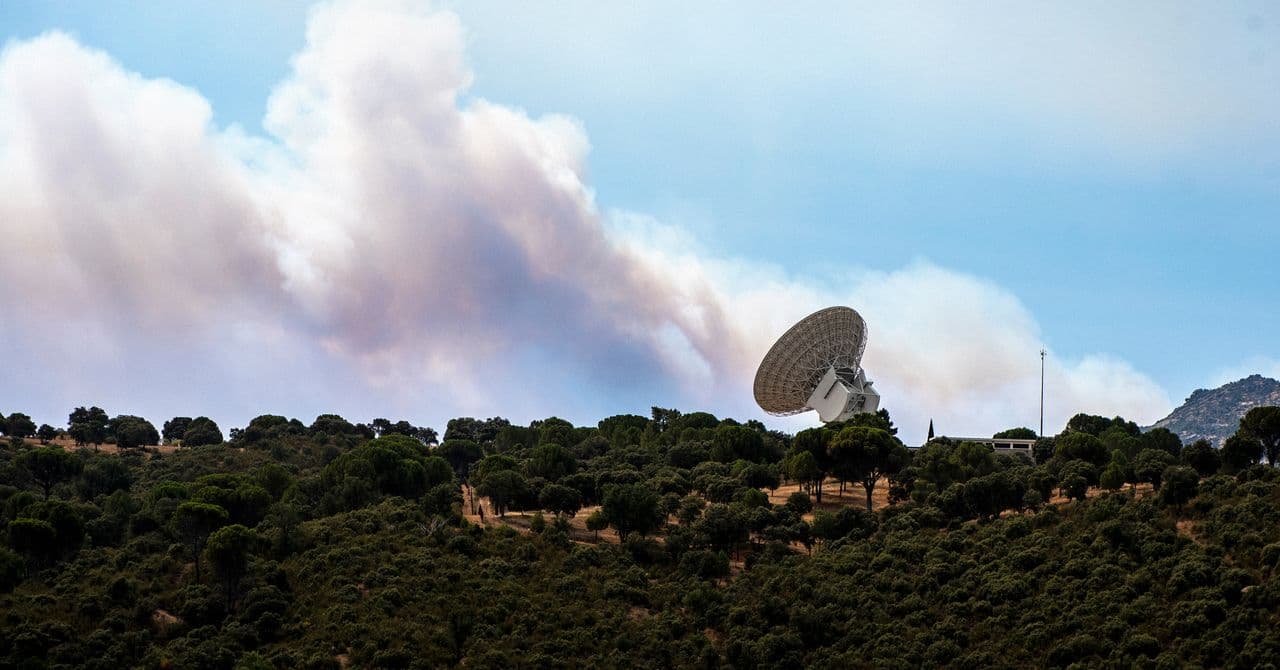
A wildfire emergency in Spain has damaged one of NASA’s key space communication facilities, the Deep Space Communications Complex near Madrid. Engineers are currently unable to assess the extent of the damage due to the ongoing situation.
This complex is part of NASA’s Deep Space Network (DSN), a worldwide system of large radio antennas that acts as humanity’s main communication link with spacecraft far beyond Earth’s orbit. You can think of the DSN as the cell tower network for space exploration. Without it, missions can’t send commands to probes or receive scientific data from them.
What Happened
Wildfires in the Madrid area forced the evacuation of the Deep Space Communications Complex, leaving the facility vulnerable as flames approached. Reports from Wired and Ars Technica confirm that NASA acknowledged the fire reached the complex. However, they haven’t been able to conduct a formal assessment of the damage while the wildfire emergency continues.
“Any potential damage will be assessed when it is safe to do so,” NASA stated, according to Ars Technica.
The agency hasn’t shared details about which specific antennas or buildings were impacted, nor if any ongoing mission communications were disrupted during the fire.
Why This Facility Matters So Much
The Madrid complex isn’t just a backup; it’s one of three DSN ground station hubs globally, alongside similar sites in Goldstone, California, and Canberra, Australia. These three locations are spaced about 120 degrees apart around the globe. This design ensures that as Earth rotates, at least one antenna always has a line of sight to any given spacecraft.
If Madrid is out of commission, coverage gaps will occur. Some spacecraft, especially those in specific orbits, could become temporarily unreachable. NASA missions that rely on real-time telemetry—data streams from spacecraft that report their health and position—would be in jeopardy during any lengthy outage.
The Madrid hub is crucial for communication with some of NASA’s most high-profile missions, including those that collaborate with the James Webb Space Telescope, which launched in 2021 and observes the universe in infrared light.
| Stat | Detail |
|---|---|
| Global Hub Locations | 3 (Madrid, Goldstone CA, Canberra AU) |
| Missions Supported | Dozens of active NASA and international spacecraft |
| Madrid Complex Location | Robledo de Chavela, approx. 60 km west of Madrid |
| Damage Assessment Status | Not yet possible — wildfire emergency ongoing |
| Current NASA Statement | “Will be assessed when it is safe to do so” |
What This Means
For most people, this won’t change your daily routine. But for NASA’s mission teams, it’s a serious operational challenge and could lead to major setbacks, depending on what the damage assessment reveals.
If the antennas are damaged or destroyed, repairs or replacements at a remote site with specialized equipment could take months. During that time, NASA would have to reroute mission communications through Goldstone and Canberra, which might mean shorter daily communication windows for some spacecraft and delayed data downloads from ongoing science missions.
The worst-case scenario is for spacecraft currently in critical mission phases. Deep space probes often need precise, time-sensitive commands during maneuvers. A gap in ground station coverage during those crucial moments could lead to significant issues.
Climate-driven wildfires are increasingly threatening vital infrastructure built decades ago, when such events were much less common in southern Europe. This incident raises important questions about how space agencies can protect ground-based assets from climate risks in the future.
Community Reaction
“People don’t realize that the DSN is just as important as the spacecraft themselves. You lose those antennas and your billion-dollar mission goes silent. This is genuinely bad.”
“The fact that there are only THREE of these sites in the entire world and one of them just burned is kind of terrifying from a redundancy standpoint.”
What To Watch
- Damage assessment timeline: NASA will provide updates once emergency crews allow access to the site. Look for an official statement shortly after the wildfire is contained.
- Mission impact disclosures: If any active NASA missions face communication issues, the agency usually logs these on its mission status pages. No such disclosures had been made at the time of publication.
- Infrastructure resilience questions: This incident will likely spark discussions in the space community about whether three globally-distributed ground stations are enough redundancy for a network supporting dozens of irreplaceable missions.
- Spain wildfire situation: The ongoing emergency near Madrid will directly affect how quickly NASA personnel can safely return to assess and begin repairs.
Sources: Wired: Spanish Wildfires Hit NASA Deep Space Observatory | Ars Technica: Wildfire Forces Evacuation of NASA’s DSN Complex in Spain

Maya Torres
Maya Torres is the Consumer Tech Editor at Explosion.com with 7 years covering product launches for major technology publications. She has reviewed over 300 devices across smartphones, laptops, wearables, and smart home products. Maya specializes in translating spec sheets into real-world buying advice and attends CES, MWC, and Apple keynotes as press. Her reviews focus on helping readers decide what to buy, not just what specs look good on paper.