Google’s making a change to ads on Search, Discover, and YouTube. They’re introducing a new label that indicates when an advertiser used artificial intelligence to create or edit those ads. This move aims to give users a clearer understanding of what they’re viewing.
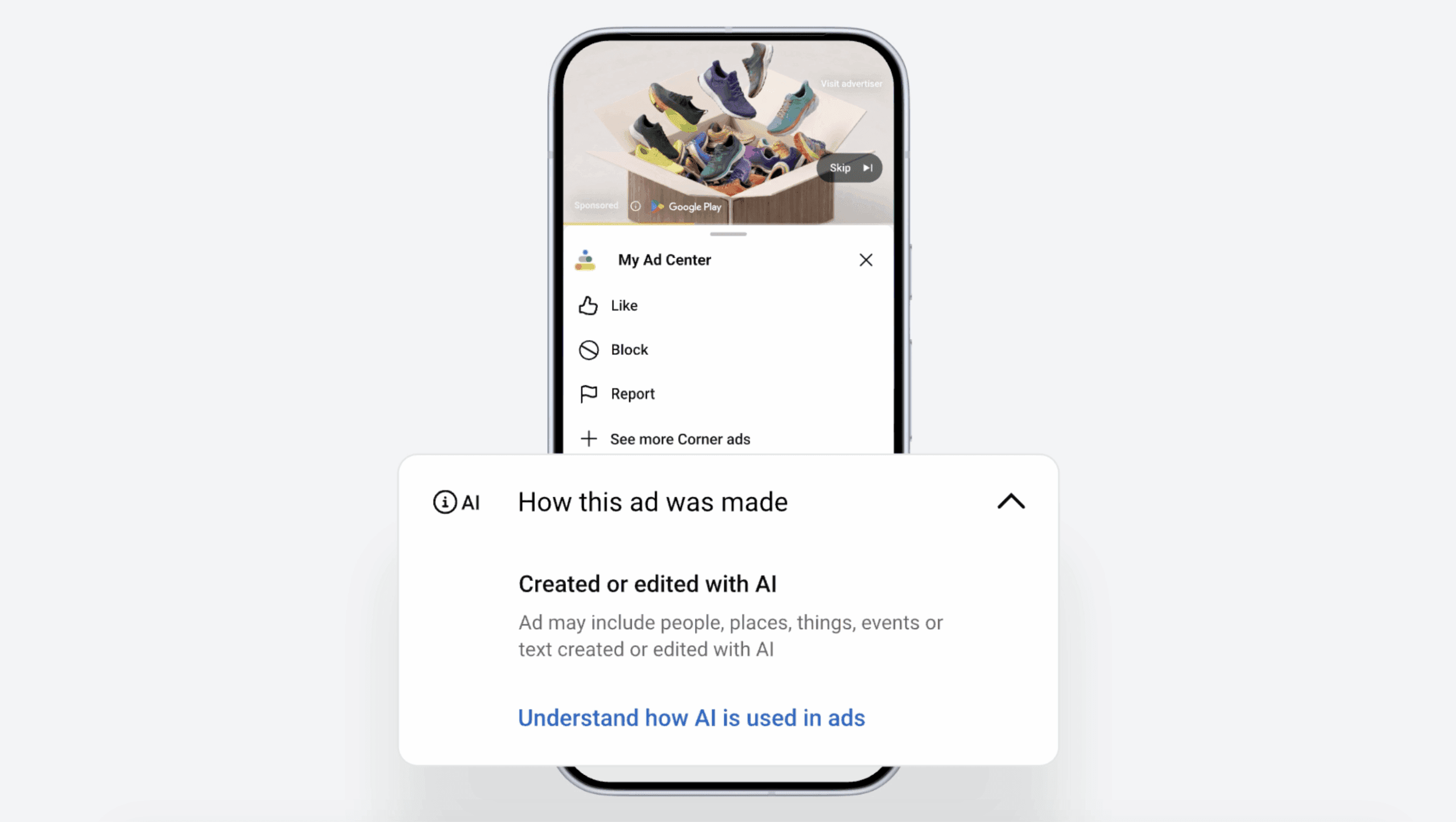
This update, announced by Google on July 9, features a “created or edited with AI” label within the “My Ad Center” tool. You can find it under a section titled “how this ad was made.” It won’t be a prominent badge on the ad itself — think of it as similar to nutritional info on food packaging: it’s there if you want to see it.
How It Actually Works
My Ad Center is already a tool that allows users to see why they’re seeing specific ads and choose the types of ads they prefer. The AI disclosure label fits right into this system.
If you come across a YouTube ad for a travel company that used an AI image generator for its visuals, you can tap the three-dot menu on the ad. Open My Ad Center and you’ll learn that the ad was AI-assisted. This label applies whether AI generated the whole ad or just enhanced an existing image or text.
According to The Verge, this disclosure will cover Google Search ads, Google Discover (the personalized feed available on Android and iOS), and YouTube ads. That’s a vast reach — those three platforms connect with billions of users daily.
Why Google Is Doing This Now
Google’s been rolling out generative AI tools for advertisers, which create new content like images, text, and video based on simple prompts. Products like Performance Max and Google’s AI-powered asset generation let businesses create ads with minimal effort. A small business owner can describe their product and get a polished ad image in seconds.
This convenience comes with a consumer concern: how do I know what’s real? The new label acts as Google’s response, at least within its advertising ecosystem.
This initiative also aligns with a growing push from regulators and advocacy groups for more transparency around AI-generated content. The European Union’s AI Act, rolling out in phases, includes requirements for AI transparency. Google’s proactive move with voluntary disclosures seems strategic.
| Metric | Detail |
|---|---|
| Company | Alphabet (GOOGL) |
| Stock Price | $346.77 (−2.17%) |
| CEO | Sundar Pichai |
| Headquarters | Mountain View, CA |
| Founded | 1998 |
| Ad platforms covered | Google Search, Google Discover, YouTube |
What This Means
For most users browsing YouTube or searching on Google, this change won’t be immediately noticeable — the label isn’t front and center. You’ll need to actively look for it in My Ad Center. It’s like the “i” button on a streaming service: useful information, but only if you know it exists and take the time to check.
Still, the implications are significant. If an advertiser uses AI to create product photos that appear too perfect or AI-written copy that makes bold health claims, the label helps you gauge how much to trust what you’re seeing. For example, an AI-generated image of a hotel room might not reflect the actual rooms accurately — something you’d want to know before booking.
Advertisers also face a reputational aspect. Some brands may view transparency about AI use as a positive indicator — modern and efficient. Others might worry it could undermine consumer trust. It’ll be interesting to see how audiences respond to the label.
Community Reactions
“Honestly a step in the right direction, but burying it in Ad Center means 99% of people will never see it. Should be right on the ad.”
— Reddit user, r/technology
“As someone who runs ads for a small business, I use AI for images all the time. I’m fine with the label — my products are real, the AI just made them look good. Curious if this hurts click rates though.”
— YouTube comment on Google Ads channel
The Bigger Picture
Google isn’t the only company considering AI content labels. Meta is testing similar disclosures on Facebook and Instagram. YouTube (owned by Google) has allowed creators to disclose AI-generated content in videos since 2023. Meanwhile, OpenAI has rebranded its Codex developer tool as it dives deeper into autonomous AI agents. Anthropic recently introduced a usage-tracking feature called “Reflect” for its Claude chatbot. These moves show that the AI industry is paying closer attention to how users interact with AI-generated content.
The advertising space is especially sensitive because ads aim to sell products. Misleading content can have higher stakes than a labeled AI art post on social media.
What To Watch
- Adoption and enforcement: Google claims advertisers using its AI tools will automatically receive the label. The real question is how they’ll manage advertisers using third-party AI tools who don’t self-report. Verification will be crucial.
- Regulatory pressure: The EU AI Act’s transparency provisions will continue unfolding through 2026 and 2027. Keep an eye on whether Google expands or strengthens these disclosures in response.
- Competitor moves: Meta and Amazon both operate large ad networks and are enhancing their AI creative tools. They’ll likely face pressure to implement similar disclosures.
- User behavior data: If Google releases data on how AI-labeled ads perform compared to non-labeled ads, it could shed light on whether consumers actually care — or if they click anyway.

Daniel Park
Daniel Park covers AI, cloud infrastructure, and enterprise software for Explosion.com. A former software engineer who transitioned to technology journalism 5 years ago, Daniel brings technical depth to his reporting on artificial intelligence, startup funding rounds, and the companies building the future of computing. He breaks down complex AI developments and business strategies into clear, actionable insights for readers who want to understand how technology is reshaping industries.