
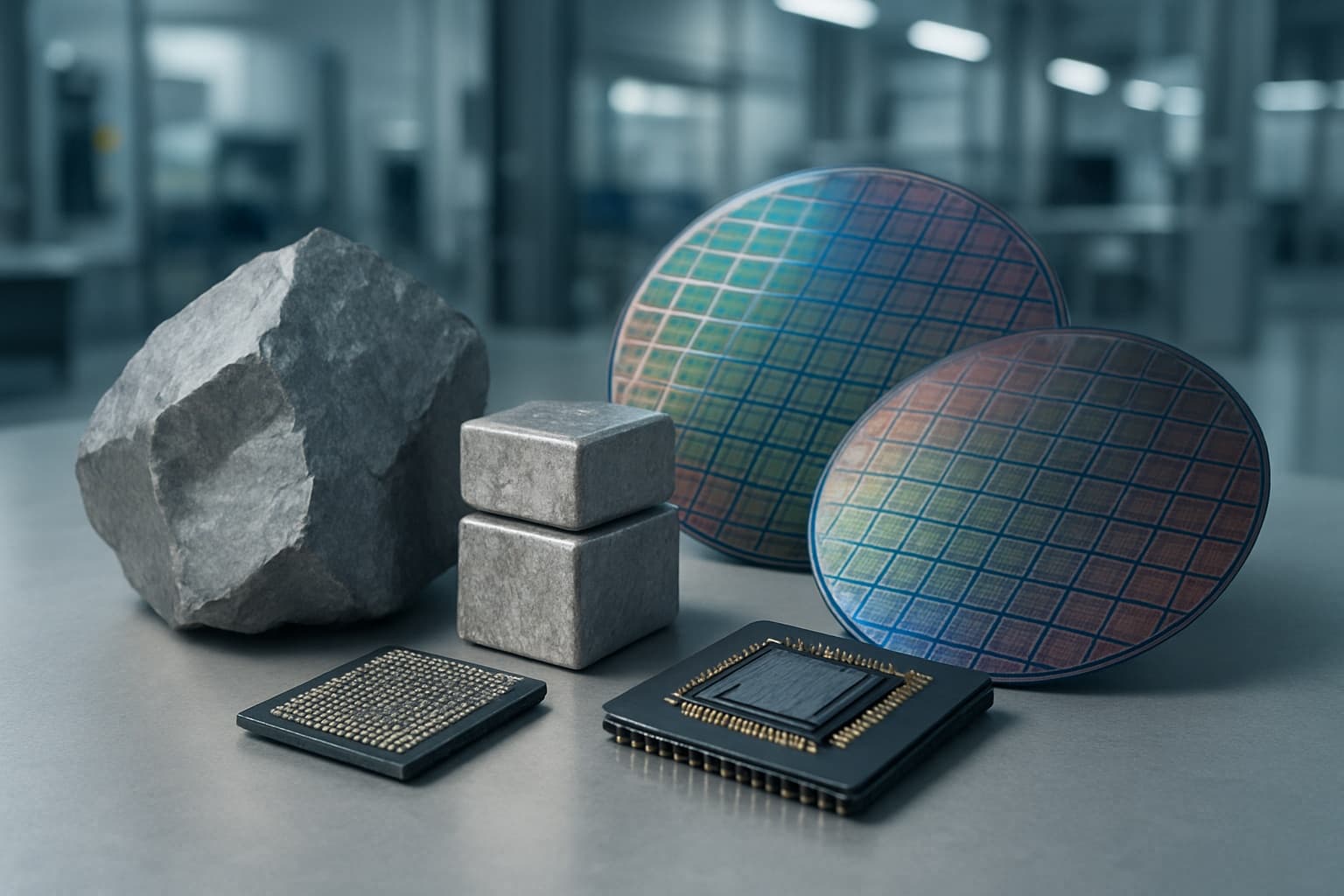
You probably think of your phone, your laptop, or even AI tools as something built out of software and code. But what if the real story is hiding in the materials you never see, the ones that quietly decide how fast technology grows and how far it can go? That is where things start to get interesting, because behind every “smart” device, there is a very physical world making it all possible.
The invisible materials behind everyday technology
Every time you scroll, stream, or ask an AI a question, you are relying on a mix of raw materials most people never think about. Data centers need massive amounts of copper for wiring, aluminum for structure, and rare earth elements for performance. Your phone depends on carefully sourced minerals that make screens responsive and batteries long-lasting. Even the idea of “cloud computing” is misleading in a way, because there is no cloud. There are huge buildings, constant cooling systems, and an ongoing demand for physical resources just to keep your digital life running. So when you think about innovation, it is not just software getting smarter. It is also about whether the physical materials underneath it can keep up.
The space race is pushing materials into a new era
Private companies are trying to turn space into something that can be used repeatedly and reliably, which changes the nature of the problem in a subtle but important way. Instead of designing for a single dramatic moment of liftoff, engineers are now dealing with systems that must endure repetition, where each flight adds a little more wear, a little more heat exposure, and a little more uncertainty about how materials will behave over time.
This is where the conversation shifts from performance to trust in materials. In environments like this, the question is not only whether something can survive a launch, but whether it can keep behaving in a predictable way after many cycles of stress that are difficult to fully replicate on Earth. That is one of the reasons titanium remains so widely used in aerospace engineering, because it offers a kind of consistency under pressure that makes long-term planning possible, even when conditions are far from stable.
This is also where USA titanium suppliers come into the conversation in a way that most people outside the industry rarely notice. Their role is not just to provide a high-grade material, but to maintain a level of uniformity and reliability across batches that aerospace manufacturing depends on, since even small variations can complicate certification and design assumptions. It is not the kind of detail that appears in public discussions about space exploration, yet it sits underneath many of the decisions that allow complex systems to move from concept to something that can actually be flown.
America’s manufacturing comeback is already happening
If the idea of a manufacturing comeback still feels, to some degree, like a convenient talking point rather than a lived reality, it becomes harder to maintain that view once you start paying attention to what is actually being built. Semiconductor plants are not only being announced but physically rising, battery factories are expanding at a pace that reflects long-term commitments rather than short-term cycles, and advanced robotics are gradually reshaping what production looks like at a structural level. What is shifting here is not only the question of where things are made, but something more fundamental about how manufacturing defines quality and control, as automation allows for levels of precision and repeatability that were previously difficult to sustain, while also encouraging companies to reconsider the value of bringing critical production closer to the environments where it is ultimately used.
What still needs to improve
Even with all this progress, there are still gaps that need to be addressed. The U.S. still relies on other countries for processing certain critical materials. Mining and refining projects take a long time to develop, which makes it harder to respond quickly to demand. There is also a growing need for skilled workers who understand both traditional manufacturing and modern automation systems. Another area that often gets overlooked is recycling. A lot of valuable materials used in electronics and batteries are still not recovered efficiently, which means opportunity is being left on the table. The future advantage will not just come from producing more, but from using resources more intelligently and building systems that waste less.
Where this all leads
The larger reality here is not only that technology is improving, but that its progress is ultimately constrained by something far less visible, which is the capacity of the physical world to keep pace with it. Every device you hold, every platform you depend on, and every emerging technology you are told will define the future rests on a foundation of materials, infrastructure, and manufacturing systems that most people rarely pause to consider, even though they are doing the essential work behind the scenes. When you start to recognize this, technology begins to look like a carefully constructed system built layer upon layer, firmly rooted in the physical reality around you.

Nick Guli
Nick Guli is the founder and editor-in-chief of Explosion.com, which he launched in February 2012. With over a decade of experience in digital publishing, Nick oversees editorial direction across entertainment, gaming, technology, and lifestyle content. He is an avid gamer and movie enthusiast who brings a critical eye to coverage of industry trends, game reviews, and entertainment news.