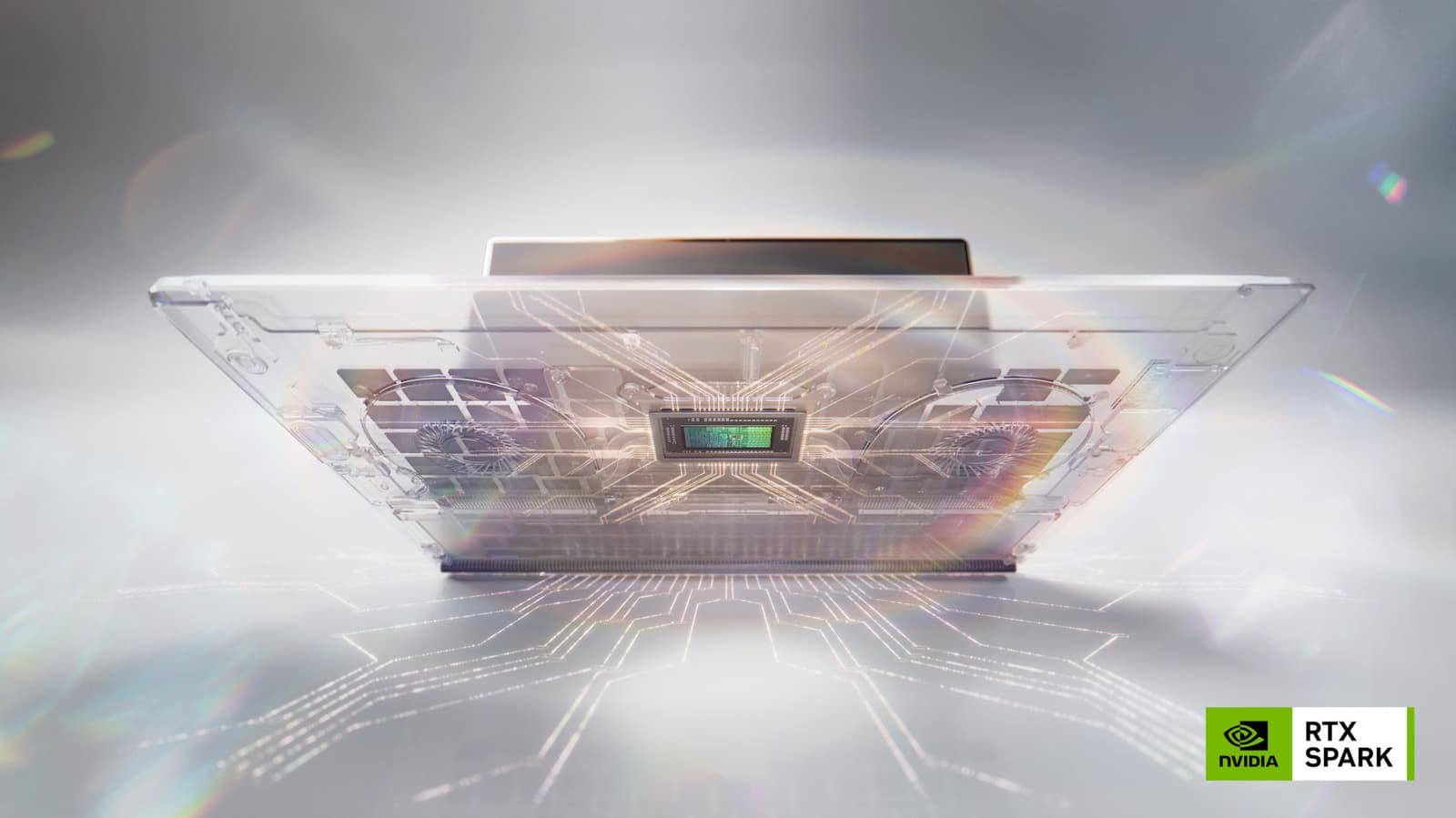
Nvidia is officially stepping into the consumer PC chip market this fall with the RTX Spark. This complete computing chip handles everything a PC needs — processing, graphics, and AI — all in one package. The company claims it’s the most efficient PC chip ever made.
This is a significant move. Nvidia has been a powerhouse in the graphics card market for years, but the RTX Spark is their first foray into creating the core processor that runs an entire computer. Now, they’re competing directly with Intel, AMD, Apple, and Qualcomm.
What Is the RTX Spark, Exactly?
Consider the RTX Spark as Nvidia’s version of Apple’s M-series chips. Instead of just making a graphics card for your PC, Nvidia is building the entire brain of the computer in one compact chip. The RTX Spark lineup features two variants — the N1 and the N1X — designed for both laptops and desktop mini-PCs.
Nvidia is touting a headline number: 1 petaflop of AI computing power. To give you an idea, a petaflop means this chip can perform one quadrillion (that’s 1,000,000,000,000,000) mathematical operations every second. For everyday users, that means AI-assisted features running directly on your device without needing a cloud connection, quicker photo and video editing, and improved performance on demanding applications.
Nvidia is also heavily promoting Windows on Arm, a version of Windows that runs on chips with Arm-based architecture, similar to what’s used in most smartphones. This type of architecture is generally more power-efficient than traditional PC chips. The RTX Spark is built on Arm architecture, which might finally give Windows on Arm the performance boost it needs to become a viable option for mainstream users.
Why Windows on Arm Needs This
Windows on Arm has faced some challenges. Microsoft and Qualcomm have been backing the platform for years, but issues with software compatibility and performance gaps compared to traditional Intel and AMD chips have hindered its success. In contrast, Apple made a smooth transition with its M1 chip in 2020.
Nvidia’s entry could change the game. The company’s software ecosystem, particularly its CUDA platform (a programming framework that lets developers tap into Nvidia’s chip power) and AI tools, is already popular among developers and researchers. If Nvidia can integrate that ecosystem into Windows on Arm laptops, it might solve the software compatibility issue that’s held the platform back.
According to XDA Developers, the RTX Spark is already set to appear in at least one powerful new laptop launching this fall, although Nvidia hasn’t revealed all its hardware partners yet.
Nvidia Is Now a Full PC Chipmaker
This fall’s launch marks a transformation for Nvidia. CEO Jensen Huang has hinted at this direction for some time, as the demand for AI computing has pushed the company to move beyond graphics cards into complete system solutions. The RTX Spark is the consumer-facing result of that strategy.
For consumers, this means more choices. If Nvidia’s chip meets its performance and efficiency claims, shoppers looking for a sleek laptop or compact desktop will have a new option that’s not based on Intel or AMD processors.
| Detail | Info |
|---|---|
| Stock Price | $211.14 (-1.45%) |
| CEO | Jensen Huang |
| Founded | 1993 |
| Headquarters | Santa Clara, CA |
| RTX Spark AI Performance | 1 petaflop |
| Chip Architecture | Arm-based |
| Target Devices | Laptops and mini-PCs |
| Expected Launch | Fall 2025 |
What This Means for Everyday Users
If you’re in the market for a new laptop or compact desktop in late 2025, the RTX Spark introduces a fresh category to consider. Here’s how that could play out:
- AI features without the cloud. Expect things like real-time background removal in video calls, AI photo editing, and smart search to run directly on your device, eliminating the need to send data to a server.
- Better battery life. Arm-based chips are often more power-efficient than traditional PC processors. If Nvidia’s efficiency claims hold up, RTX Spark laptops could provide significant improvements in battery life.
- More competition on price. Nvidia’s entry into the market puts pressure on Qualcomm, Intel, and AMD. Increased competition usually leads to better value for consumers over time.
- Software to watch. Windows on Arm still faces some app compatibility issues. Not all Windows programs run natively on Arm chips yet, but Microsoft is actively working on improving this through emulation.
Community Reactions
“Nvidia jumping into full SoC [system-on-chip] territory is wild. If they maintain their driver quality and software support, this could actually make Windows on Arm viable for real work.”
“I’ll believe the 1 petaflop claim when I see independent benchmarks. Marketing numbers from chip companies always need a reality check before getting excited.”
What To Watch
- Fall 2025 launch window. Nvidia has confirmed a fall release for the first RTX Spark-powered devices. Expect specific hardware announcements from laptop makers in the coming months.
- Independent benchmarks. The real test will happen when reviewers get hands-on time with RTX Spark machines and can compare them with Qualcomm’s Snapdragon X Elite chips and Apple’s M-series processors.
- Software compatibility updates. Keep an eye on Microsoft as they ramp up efforts for Windows on Arm app compatibility ahead of the launch. The more apps that run natively, the stronger the case for RTX Spark devices.
- Nvidia’s hardware partners. At least one laptop is already confirmed. Additional partnerships with PC makers like Dell, HP, Lenovo, or Asus would indicate how broadly Nvidia plans to introduce the RTX Spark into the market.
Sources: Engadget, XDA Developers, The Verge

Daniel Park
Daniel Park covers AI, cloud infrastructure, and enterprise software for Explosion.com. A former software engineer who transitioned to technology journalism 5 years ago, Daniel brings technical depth to his reporting on artificial intelligence, startup funding rounds, and the companies building the future of computing. He breaks down complex AI developments and business strategies into clear, actionable insights for readers who want to understand how technology is reshaping industries.