
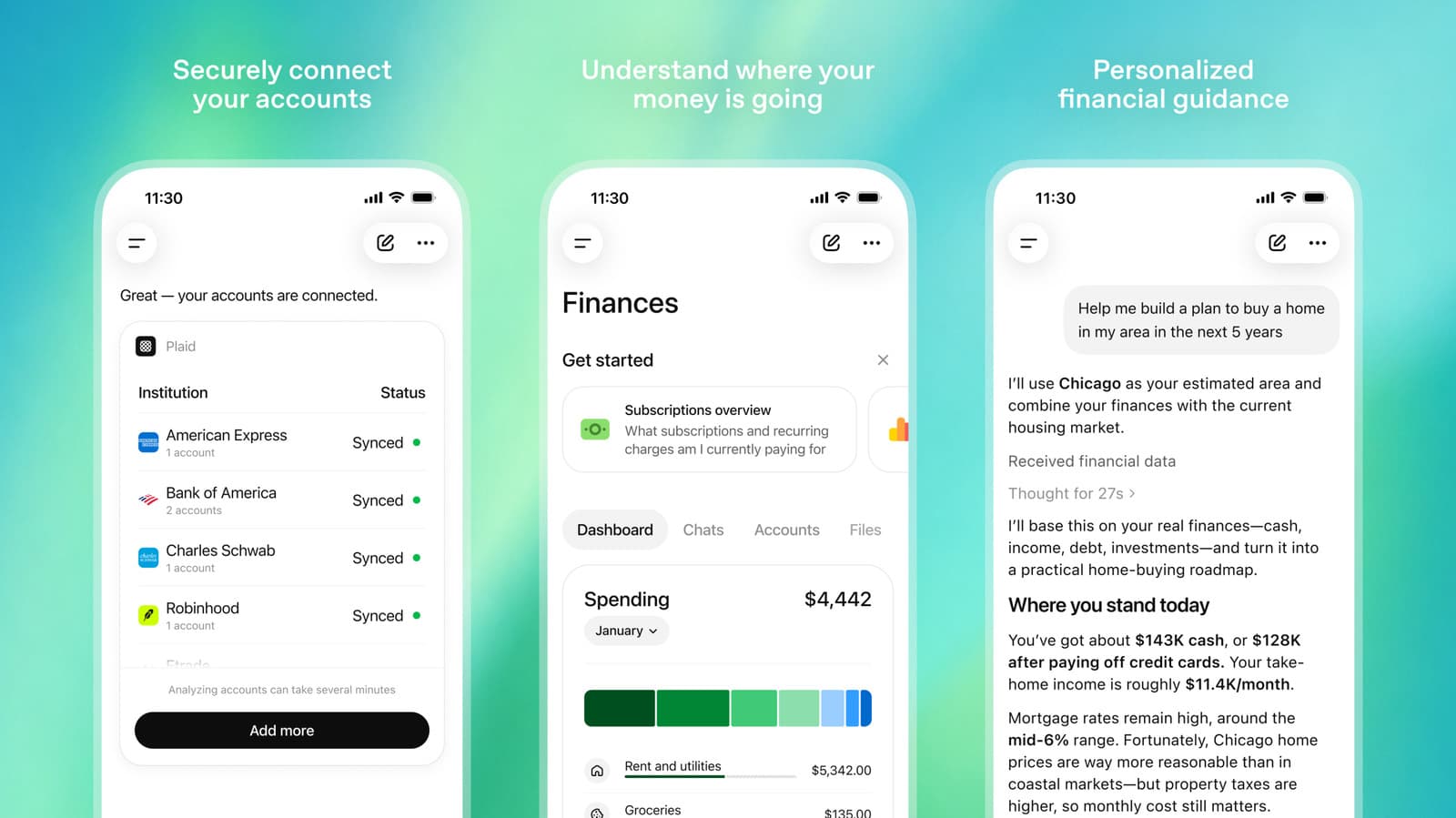
OpenAI is introducing a feature that allows ChatGPT to connect directly to your bank accounts. This gives the AI chatbot access to your actual spending data, enabling it to provide personalized financial advice.
This integration uses Plaid, a service that securely links financial apps with banks. Think of Plaid as the translator that allows apps like Venmo or Robinhood to interact with your bank without requiring your login credentials. OpenAI announced this feature in preview, and it covers over 12,000 financial institutions.
How It Works
When you opt in, ChatGPT can access your transaction history, account balances, and spending habits. Instead of providing the AI with rough estimates — like saying “I spend about $400 a month on groceries” — it can see exactly what you spend and when. This means it can offer advice based on your real financial behavior instead of your approximations.
The connection is optional. You can link your accounts via Plaid’s interface, which is the same process many people already use with budgeting apps like Mint or YNAB. OpenAI describes this as a “secure connection,” but they haven’t yet detailed what data ChatGPT stores or how long it keeps it.
Why Plaid?
Plaid has established itself as a trusted infrastructure in the financial app ecosystem. It connects over 8,000 apps and partners with most major U.S. banks. By using Plaid, OpenAI avoids the hassle of creating its own banking connection system. Users can also follow a familiar consent flow.
However, Plaid has faced privacy issues in the past. In 2022, the company settled a $58 million class action lawsuit for allegedly collecting more financial data than users consented to. Following that, they updated their practices.
What This Means for Everyday Users
If you’ve always wanted a financial advisor but found the cost prohibitive, this feature is designed for you. Traditional advisors usually charge between $150 and $400 per hour or require minimum account balances of $250,000 or more. ChatGPT already costs $20 a month for the Plus tier.
The practical benefit? You could ask ChatGPT questions like “Where am I overspending compared to last quarter?” or “Can I afford to add $200 a month to my savings if I cut subscriptions?” It will provide answers based on your actual spending, not just guesses.
On the downside, remember this is still an AI, not a licensed financial advisor. ChatGPT doesn’t have fiduciary duty, which means it isn’t legally obligated to act in your best financial interest like a registered advisor would. Treat its advice as a starting point for your own thinking.
The Privacy Question
Linking a bank account to any third-party service always comes with risks, and this connection poses greater stakes than, say, linking your Spotify to a playlist app. Your transaction history can reveal where you live, work, eat, and spend your money, as well as your financial struggles.
OpenAI hasn’t published a complete breakdown of its data retention policies for this feature yet. Users considering this connection should check OpenAI’s privacy settings and see if financial data from Plaid connections will be used to train future models. That’s an important question.
| By The Numbers | |
|---|---|
| Financial institutions covered | 12,000+ |
| Apps currently using Plaid | 8,000+ |
| OpenAI founded | 2015 |
| ChatGPT Plus monthly cost | $20/month |
| Average hourly cost of a human financial advisor | $150–$400/hour |
| Plaid 2022 class action settlement | $58 million |
Community Reaction
Online reactions show a mix of excitement and skepticism. On Reddit’s r/ChatGPT, user u/throwaway_fin_lurker commented: “The accessibility angle is real. A lot of people genuinely can’t afford a financial advisor, and this could fill that gap. But I’m not connecting my bank to OpenAI until I read every word of their data policy.”
On YouTube, a commenter on The Verge’s coverage stated: “Plaid already knows everything about my spending. At least now maybe something useful comes out of all that data access.” — @devnull_finance
What To Watch
- Full privacy documentation: OpenAI launched this feature in preview. Before a wider rollout, expect a detailed explanation of what financial data gets stored, how long it’s kept, and if it’s used in model training.
- Regulatory attention: Features involving financial advice often attract scrutiny from the SEC and CFPB (Consumer Financial Protection Bureau). Keep an eye out for any regulatory statements regarding AI-driven financial guidance.
- Competitor moves: Google’s Gemini and Anthropic’s Claude haven’t introduced similar bank integrations. If ChatGPT’s version gains traction, expect competitors to follow suit quickly.
- Broader rollout timeline: This feature launched in preview, but a general availability date hasn’t been set yet.

Maya Torres
Maya Torres is the Consumer Tech Editor at Explosion.com with 7 years covering product launches for major technology publications. She has reviewed over 300 devices across smartphones, laptops, wearables, and smart home products. Maya specializes in translating spec sheets into real-world buying advice and attends CES, MWC, and Apple keynotes as press. Her reviews focus on helping readers decide what to buy, not just what specs look good on paper.


