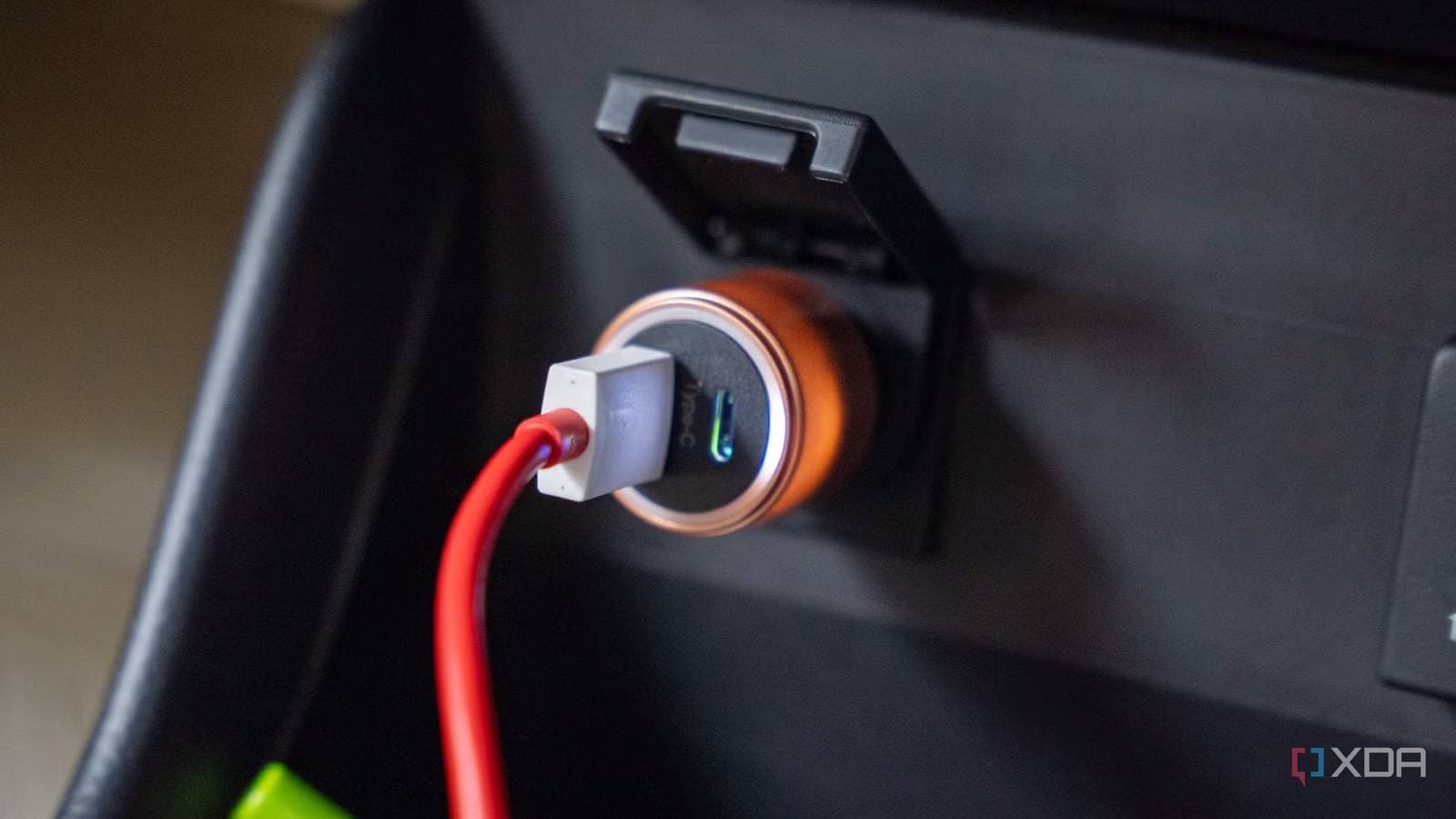
Your car’s built-in USB port probably isn’t charging your phone effectively — it might even be draining it faster. Switching to a dedicated 12V USB-C car charger is a quick fix that tackles one of the biggest annoyances for anyone using their phone for navigation, music, or hands-free calls while driving.
The Problem With Your Car’s Built-In USB Port
Most factory-installed USB ports in cars provide about 5 watts of power. This sounds reasonable, but when you’re driving, your phone’s screen, GPS, and cellular radio are all active. Together, they can draw more power than 5W can supply. Consequently, your phone might charge so slowly that it actually loses battery percentage during a long drive, even while plugged in.
Imagine trying to fill a bathtub with the drain open. If the water flow into the tub is slower than what’s draining out, it’ll never fill up.
Modern smartphones, especially recent Android models and iPhones, support fast charging standards that can deliver anywhere from 18W to 65W or even more. Your car’s USB-A port (the rectangular one that’s been standard for about 15 years) just can’t keep up.
The Fix: A 12V USB-C Car Charger
A 12V car charger — the type that fits into your cigarette lighter socket (the round power outlet in most car dashboards) — can provide much more power than your car’s built-in USB ports. Newer models support USB-C with Power Delivery (a charging standard that allows the charger and device to negotiate the fastest safe charging speed), meaning your phone charges at the same rate it would from a wall outlet.
According to XDA Developers, switching to a 12V charger can ensure that a phone that used to die during a two-hour drive now arrives fully charged — or nearly so.
This upgrade typically costs between $15 and $40 for a good quality single-port charger. Just plug it into the cigarette lighter socket, connect your phone with a USB-C cable, and you’re set.
What to Look For When Buying One
Wattage
Look for at least 30W output for charging one phone. If you’re charging two devices at the same time, aim for 65W or more to prevent throttling.
USB-C With Power Delivery
Ensure the charger clearly states USB-C Power Delivery (PD). Older USB-A car chargers marked as “fast charging” often use proprietary standards that only work with specific devices.
Multiple Ports
If you often travel with others or have several devices, consider a multi-port charger. Anker’s 140W Max four-port charger — which offers both USB-C and USB-A ports — is available at Walmart for $65, down from about $130, according to CNET. It can fast-charge a phone, tablet, and laptop all at once.
| By The Numbers | |
|---|---|
| Typical factory car USB output | 5W |
| Average phone power draw during active navigation | 3–6W |
| USB-C PD car charger output (entry level) | 30W |
| Anker 140W Max total output | 140W across 4 ports |
| Anker 140W Max current price (Walmart) | $65 (was ~$130) |
| Upgrade cost for a single-port car charger | $15–$40 |
What This Means For You
If you’ve ever reached your destination with your phone at 20% despite being plugged in the entire time, this is your solution. A USB-C PD car charger means:
- Navigation stays on: Google Maps and Apple Maps can run continuously without draining your battery faster than it charges.
- No more charger swapping: USB-C is now the standard on most Android phones and all recent iPhones. One cable works for everything.
- Road trips become easier: Passengers can charge devices quickly instead of dealing with a slow trickle from the back USB port.
- Emergency preparedness: Arriving at your destination with a fully charged phone enhances safety, especially on long drives.
The only downside is giving up the convenience of the built-in port. Since most 12V chargers fit snugly with the dashboard, this isn’t usually a problem.
What People Are Saying
“I had no idea the car USB was only 5 watts. I thought my phone was just broken because it always died on road trips. Got a 45W USB-C charger for $20, and it’s like a completely different experience.”
“The Anker multi-port car chargers are genuinely the move. I have one that handles my phone, my wife’s phone, and an iPad all at once without any of them slowing down. Game changer for family road trips.”
What To Watch
- USB-C universal adoption: With the EU mandate requiring USB-C on all phones sold in Europe fully in effect, expect to see more accessories dropping USB-A ports entirely. Buying USB-C now future-proofs your setup.
- Anker 140W deal: The current $65 price at Walmart is a limited promotion. If you need a multi-port option, grab it before it’s gone.
- Car manufacturers catching up: Some newer vehicles, including recent Tesla models and 2024+ Ford and GM trucks, are starting to feature higher-wattage USB-C ports from the factory. If you’re buying a new car, check the spec sheet — you might not need the upgrade at all.

Daniel Park
Daniel Park covers AI, cloud infrastructure, and enterprise software for Explosion.com. A former software engineer who transitioned to technology journalism 5 years ago, Daniel brings technical depth to his reporting on artificial intelligence, startup funding rounds, and the companies building the future of computing. He breaks down complex AI developments and business strategies into clear, actionable insights for readers who want to understand how technology is reshaping industries.