
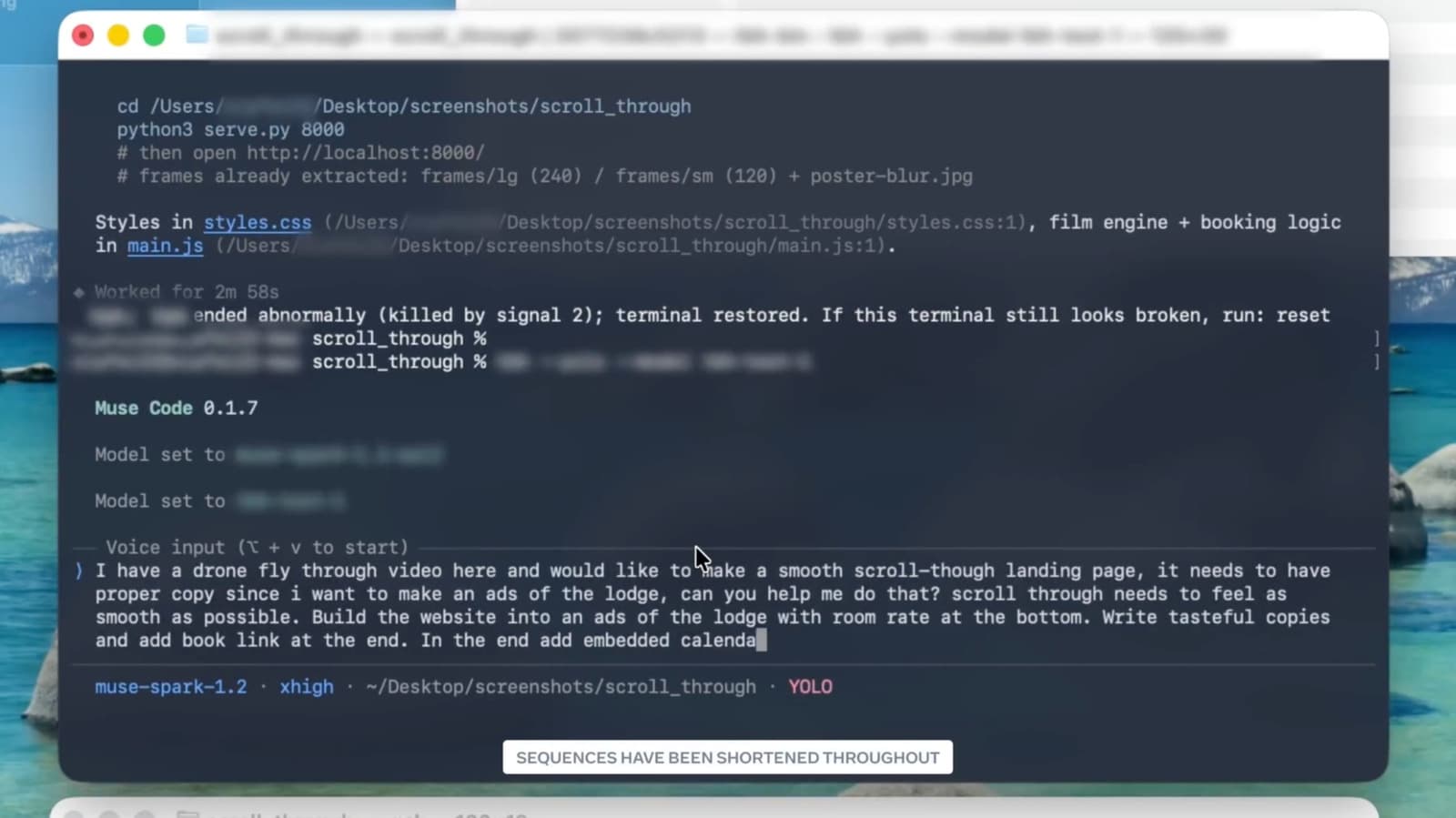
Meta has jumped into the AI coding assistant scene with two new offerings: Muse Code, a terminal-based coding agent currently in public beta, and Muse Spark 1.2, the AI model behind it. This move puts Meta in direct competition with GitHub Copilot, Anthropic’s Claude Code, and Google’s Gemini CLI.
| Meta — By The Numbers | |
|---|---|
| Ticker | META (+0.14%) |
| Stock Price | $588.77 |
| CEO | Mark Zuckerberg |
| Headquarters | Menlo Park, CA |
| Founded | 2004 |
| Sector | Social / AI |
What Is Muse Code?
Muse Code is a terminal-based AI coding agent. It operates in the command-line interface, which developers use to run programs and manage files. You give it instructions, and Muse Code analyzes your existing codebase, solves problems, and writes or edits code for you.
Meta claims Muse Code is designed specifically for large codebases. These are extensive, interconnected collections of code that drive real products, often containing millions of lines created by numerous engineers over many years. Most AI coding tools struggle with such large projects since understanding how different parts of the code connect requires a lot of context.
The “Async Background Agent” Difference
The standout feature of Muse Code is its support for persistent async background agents. This means Muse Code can run tasks in the background without needing your constant attention.
Imagine sending an email to a contractor instead of watching them work live. You specify what you need — like “refactor this authentication system” or “find and fix all broken API calls in this module” — and Muse Code goes off to handle it while you focus on other tasks. The results will be ready when you return.
This is a significant improvement over tools that require constant back-and-forth in a chat window. It aligns with what competitors like Anthropic’s Claude Code and OpenAI’s Codex have been pursuing.
Meet Muse Spark 1.2
Muse Code is powered by Muse Spark 1.2, a new AI model from Meta’s research division. While Meta hasn’t released a comprehensive technical overview of Muse Spark 1.2’s architecture, it aims to be a coding-specialized model focused on understanding and generating code for large, complex software projects.
Meta’s Llama model family, which includes open-source AI models, has gained popularity in the developer community. This gives the company credibility with technical audiences. Muse Spark 1.2 seems to be a dedicated, task-specific model rather than a general-purpose one — think of it as a specialist rather than a jack-of-all-trades.
A Crowded Market
Meta is entering a competitive market filled with major players. GitHub Copilot, supported by Microsoft and OpenAI, boasts millions of users integrated into VS Code and other editors. Anthropic’s Claude Code has garnered strong praise from developers for handling complex, multi-file tasks. Google’s Gemini CLI takes a similar terminal-based approach.
What Meta offers is scale — both in engineering talent and data assets from operating some of the world’s largest software infrastructures. Whether Muse Spark 1.2 can actually outperform its rivals in real-world coding tasks will depend on independent benchmarks.
Community Reaction
“Async background agents sound great on paper, but the real test is how well it deals with merge conflicts after running unsupervised for 20 minutes. That’s usually where these tools struggle.”
— u/bytewrangler99, r/MachineLearning
“Meta has the infrastructure knowledge to make this genuinely useful for monorepos. I’m keen to see benchmarks against Claude Code on real enterprise projects.”
— Comment on TechCrunch YouTube coverage of the launch
What This Means for Everyday Users
If you’re not a developer, this news probably won’t change your daily routine right away. However, AI coding tools are speeding up software development, which means apps, features, and bug fixes will reach you faster.
For developers, especially those in large teams tackling complex products, an effective background coding agent could save a lot of time on tedious tasks like refactoring old code, writing tests, or identifying bugs. The beta period will show if Muse Code can deliver on that promise at scale.
Meta is currently offering Muse Code in beta, with more details on broader availability expected in the coming months. You can find more information in VentureBeat’s full breakdown, TechCrunch’s coverage of large codebase support, and Engadget’s overview of the terminal-based tool.
What To Watch
- Independent benchmarks: Look out for third-party coding benchmark results that compare Muse Spark 1.2 with Claude Code, Gemini CLI, and GitHub Copilot. These should appear within weeks of the beta launch.
- Beta to general availability: Meta hasn’t confirmed a public launch date yet. Keep an eye out for pricing announcements — whether Muse Code will be free, subscription-based, or usage-priced will affect developer adoption.
- Editor integrations: Currently, Muse Code operates in the terminal. If Meta develops a VS Code or JetBrains plugin, it could significantly broaden its user base.
- Enterprise deals: Competitors like GitHub Copilot have secured major contracts with businesses. News of Muse Code landing big clients would indicate it’s a serious long-term contender.

Daniel Park
Daniel Park covers AI, cloud infrastructure, and enterprise software for Explosion.com. A former software engineer who transitioned to technology journalism 5 years ago, Daniel brings technical depth to his reporting on artificial intelligence, startup funding rounds, and the companies building the future of computing. He breaks down complex AI developments and business strategies into clear, actionable insights for readers who want to understand how technology is reshaping industries.