
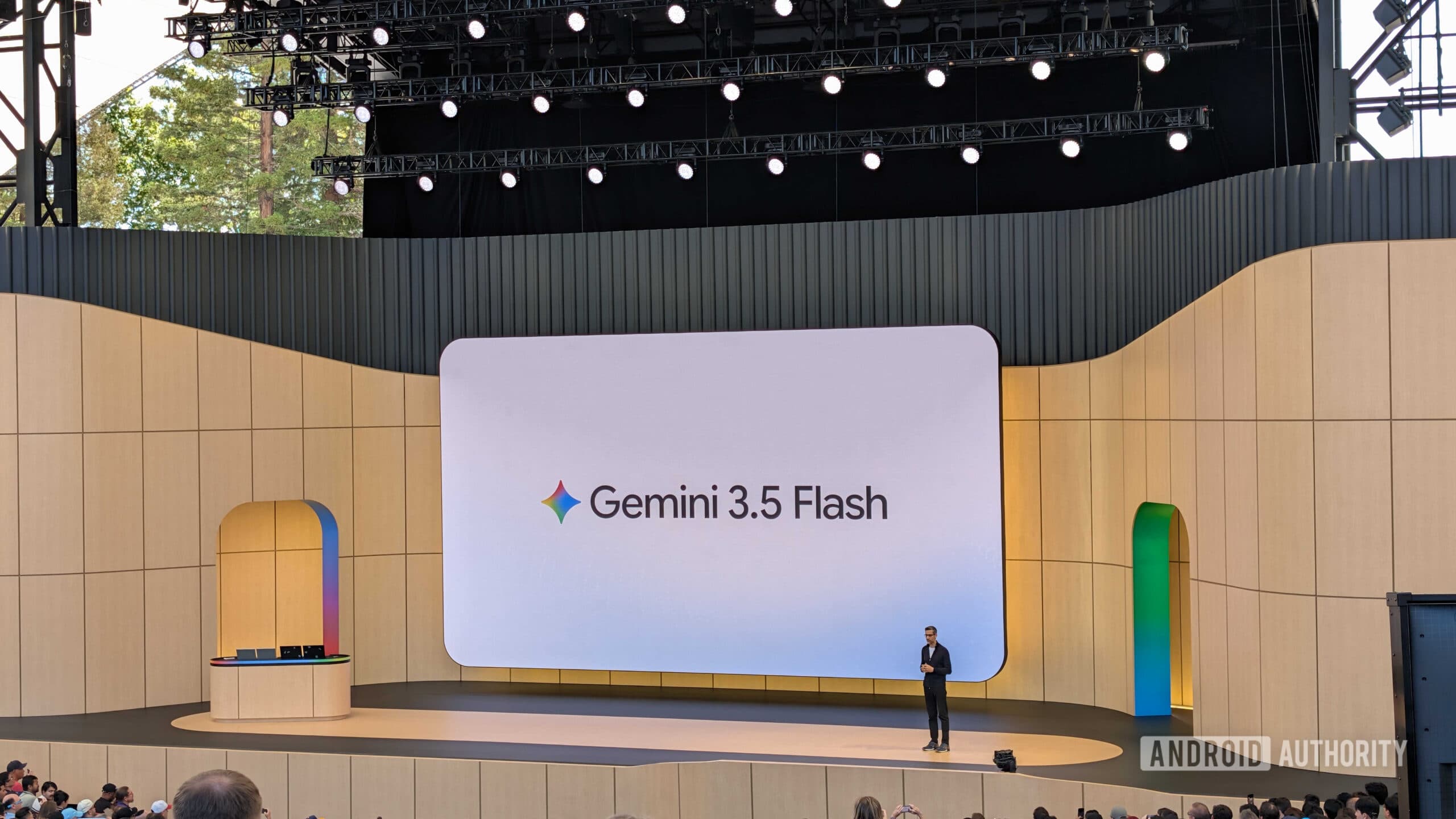
Google introduced Gemini 3.5 Flash at Google I/O 2026. Its main selling point is clear: this speed-oriented model now outperforms older Gemini Pro models in coding and agentic tasks. Agentic AI refers to systems that can take actions on your behalf, like booking flights or writing and executing code.
| Ticker | GOOGL |
|---|---|
| Stock Price | $386.00 (-0.43%) |
| CEO | Sundar Pichai |
| Headquarters | Mountain View, CA |
| Founded | 1998 |
| Model Name | Gemini 3.5 Flash |
| Announced | Google I/O 2026 (May 19, 2026) |
What Is Gemini 3.5 Flash?
The “Flash” label in Google’s lineup highlights models designed for speed and efficiency rather than sheer power. Imagine it as the difference between a sports car meant for daily driving and one built exclusively for racing. Flash models aim to respond quickly and operate at lower costs, making them ideal for widespread use.
What’s impressive about 3.5 Flash is that it has crossed an important benchmark: according to Android Authority, it now surpasses older Pro-tier models in tough agentic and coding benchmarks. In simple terms, the faster, more affordable version of Gemini is now smarter than its pricier predecessor from a previous generation.
Better Coding and AI Agents: What That Actually Means
Coding Improvements
For developers, enhanced coding performance means Gemini 3.5 Flash can generate longer, more precise code blocks. It can catch more bugs before they lead to problems and handle complex multi-step programming instructions without going off track. This also matters for non-developers since AI assistants in apps like Google Workspace or Android use these models to automate tasks.
Agentic Capabilities
“Agentic” AI is a hot topic in the tech industry right now. Unlike traditional systems that answer one question, an agentic AI can complete a series of tasks: it can search the web, open a calendar, draft an email, and send it all in response to a single prompt. The improvements in Gemini 3.5 Flash suggest Google is setting it up as the backbone for products like Gemini Live and Project Astra, which aim to function as ongoing AI assistants running quietly in the background of your phone or computer.
Gemini Omni Also Announced
Google didn’t stop with 3.5 Flash. At the same event, they unveiled Gemini Omni, a model described as a “world model” with advanced video generation capabilities, according to Mashable. A world model refers to an AI system that develops an internal understanding of physical environments and cause-and-effect relationships, not just text patterns. This concept is similar to what companies like DeepMind are pursuing for robotics and simulation. Combining that with video generation indicates Google is working toward AI that can understand and create video content while grasping how the real world operates.
What This Means for Everyday Users
If you use Google Search, Gmail, Google Docs, or an Android phone, Gemini 3.5 Flash will likely work behind the scenes in features you already use. Faster coding performance means that Workspace’s AI writing tools should deliver cleaner results. Enhanced agentic capabilities mean features like “Help Me” in Gmail or Google Assistant tasks should manage multi-step requests more smoothly, without getting confused midway.
For those using the Gemini app directly, the main benefit is speed without sacrificing intelligence. Google’s pitch is that you won’t have to choose between a sluggish, smart model and a quick, unintelligent one anymore.
The competitive landscape matters here as well. OpenAI’s GPT-4o mini and Anthropic’s Claude Haiku sit in the same “fast and affordable” category. Google’s claim that its Flash model now outperforms older Pro-level models is a clear challenge to rivals in that space.
Community Reactions
“Flash beating Pro models on coding benchmarks is actually a big deal. That’s not just marketing — if it holds up in real use, this is the model everyone will be routing to by default.”
“I’ll believe the agentic stuff when I see it work without breaking halfway through a task. Every model claims this now. Show me it actually books my dentist appointment without asking me five clarifying questions.”
What To Watch
- Independent benchmark testing: Google’s benchmarks tend to favor Google. Third-party evaluations from platforms like LMSYS Chatbot Arena and Artificial Analysis will provide clearer insights into whether 3.5 Flash’s improvements hold up in real-world conditions.
- Gemini Omni availability: Google announced Omni at I/O but hasn’t yet confirmed when it will roll out to the public. Keep an eye out for developer preview access in the coming weeks via Google AI Studio.
- Gemini app updates: Google often follows I/O announcements with staged releases over several weeks. Users of the Gemini app should expect model options to update through May and June 2026.
- Competitor response: OpenAI and Anthropic usually respond to major model launches within days or weeks. Both companies have updates expected this spring, and Google’s Flash improvements could speed up those timelines.

Daniel Park
Daniel Park covers AI, cloud infrastructure, and enterprise software for Explosion.com. A former software engineer who transitioned to technology journalism 5 years ago, Daniel brings technical depth to his reporting on artificial intelligence, startup funding rounds, and the companies building the future of computing. He breaks down complex AI developments and business strategies into clear, actionable insights for readers who want to understand how technology is reshaping industries.


