Google has revealed a major redesign of Android Auto at its I/O 2026 event. The update introduces a new visual style, home screen widgets, video app support, 3D maps, and enhanced Gemini AI integration for the in-car software platform.
What’s Actually Changing
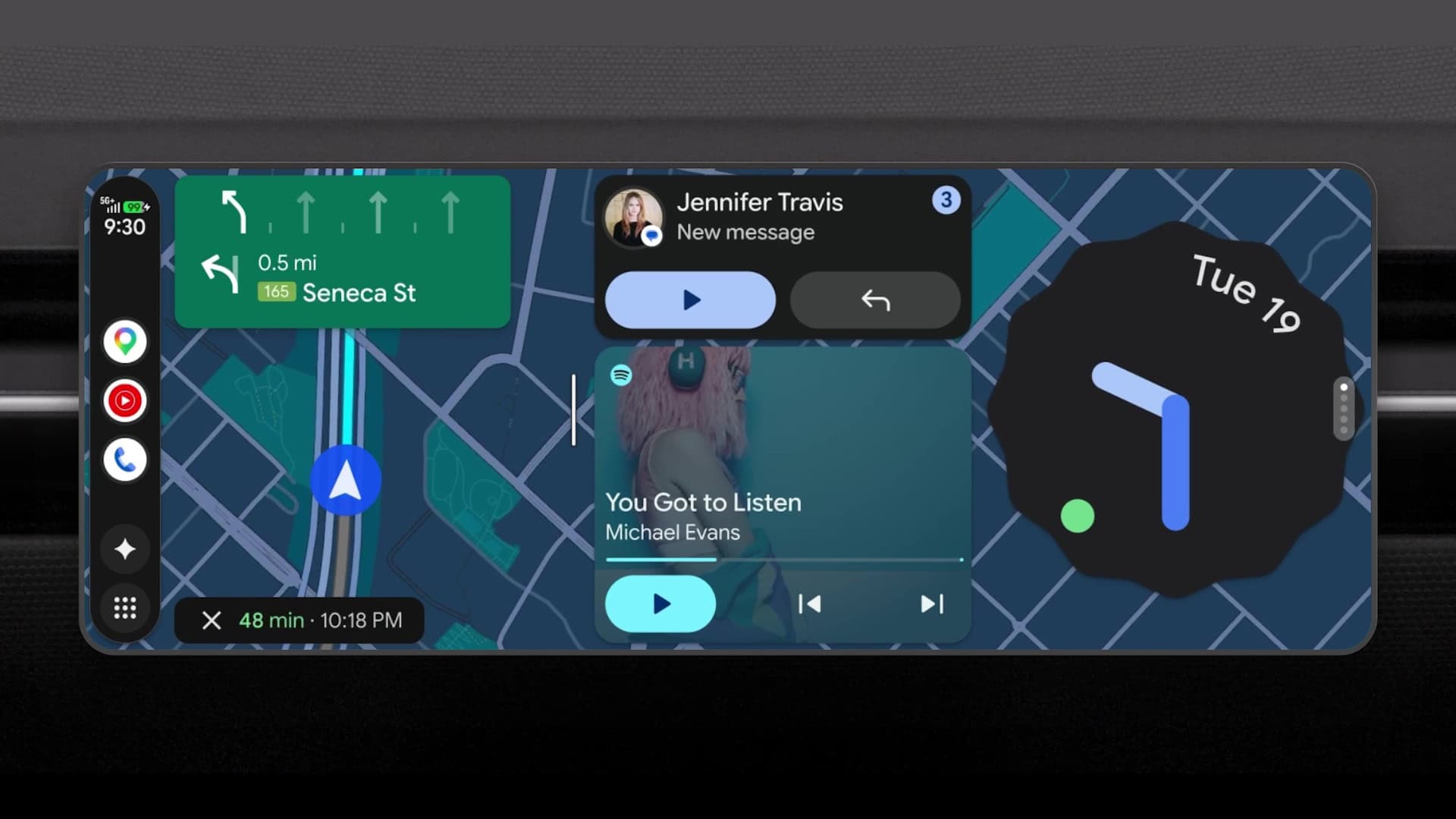
The most noticeable change is the shift to Material 3 Expressive, Google’s latest design language. This new style focuses on bolder colors, rounder shapes, and more animated transitions. If you’ve seen how colorful and fluid Google’s phone apps have become, you can expect the same for your car’s screen.
Picture this as your car’s dashboard receiving the same refresh your phone did with a recent Android update. It’ll be cleaner, more modern, and easier to read at a glance.
Widgets Are Coming to Your Dashboard
Android Auto will now support home screen widgets, similar to the ones you can add to your phone’s home screen. This means that apps like Spotify, Google Calendar, or weather services can show live information directly on your car’s main screen without needing to open a full app.
This change is a big win for drivers who currently have to navigate through menus for simple tasks. A glanceable widget displaying your next calendar appointment or the current song could save you several taps during your trips.
Video Apps While Parked
Google is also opening Android Auto to video streaming apps. But here’s the catch: this feature is only available while the car is parked, not during driving. So, if you’re waiting to pick someone up or sitting in a long drive-through line, you can watch video content on your car’s screen instead of reaching for your phone.
Immersive 3D Maps
Google Maps in Android Auto is getting a 3D upgrade with improved building and terrain rendering. This enhancement will help with spatial awareness in crowded city areas where flat 2D maps make it tough to identify buildings.
Gemini AI Gets Into the Car
Google’s Gemini AI assistant, the company’s primary AI product integrated into Android, is becoming more embedded in Android Auto. Google states that Gemini will manage more complex voice commands and contextual requests while driving, going beyond the simpler tasks Google Assistant has handled in cars.
These features will also be available in cars with Google built-in (like certain Volvo, Polestar, and GM models that run Android directly in the vehicle without needing a connected phone).
| Android Auto 2026 — By The Numbers | |
|---|---|
| Android Auto users worldwide | ~235 million (as of 2025) |
| Car brands supporting Android Auto | 500+ |
| New feature categories announced | 5 (UI, widgets, video, maps, AI) |
| Rollout timeline | Staged throughout 2026 |
| Platforms covered | Android Auto + Google built-in |
What This Means for Everyday Drivers
If you connect your Android phone to your car or use Bluetooth for Android Auto now, you’ll see these updates as software updates roll out — no new hardware needed for most features.
The widget support is likely the most immediately helpful addition for the average driver. Having music controls, navigation status, or a quick calendar view on screen without tapping around can make a huge difference over countless commutes.
The video app support is a nice feature for those who spend time waiting in their cars. Just remember, it’s only available when parked. Google has been cautious not to create features that could lead to distracted driving.
Keep an eye on the Gemini integration over time. Currently, Google Assistant in cars handles basic commands pretty well. However, it struggles with more complex requests, like “find a parking garage near my destination that’s open past 10pm.” If Gemini can reliably manage those layered questions, it’ll greatly improve the daily driving experience.
Community Reactions
“Finally. Android Auto’s UI has looked dated for years. The widget support alone is going to make my commute less annoying — I just want to see my next nav step and song title without hunting through menus.”
“The video app thing sounds cool but I’ll believe the AI improvements when I see them. Google Assistant in my car still can’t reliably send a text message on the first try.”
How This Fits Into Google’s Bigger 2026 Plans
The Android Auto update is just one part of a larger overhaul Google announced at I/O 2026, focusing on AI features powered by Gemini. According to Ars Technica, much of Google’s Android roadmap for 2026 revolves around AI, and the car is clearly a priority for the company.
Android Authority notes that these features will roll out throughout the year instead of all at once, so not everything announced today will be available immediately.
Also, the car software space is becoming more competitive. Rivian just announced its own AI-powered voice assistant for all Gen 1 and Gen 2 vehicles, showing that automakers are increasingly developing their own intelligent in-car experiences instead of relying solely on Google or Apple.
What To Watch
- Staged rollout through 2026: Google hasn’t specified exact dates for each feature. Keep an eye out for Android Auto app updates in the Play Store and check your car’s compatibility as features become available.
- Google built-in vehicles: Drivers with Volvo, Polestar, and supported GM vehicles should receive updates via their car’s OTA (over-the-air) software update system.
- Gemini in-car performance: The real test will be how well Gemini manages complex, real-world voice commands. User reports after the broad rollout will reveal if this is a genuine improvement or just a rebrand of existing capabilities.
- Third-party video apps: Google hasn’t announced which streaming services will support Android Auto for video. Major apps like Netflix and YouTube will need to update to utilize this feature.

Daniel Park
Daniel Park covers AI, cloud infrastructure, and enterprise software for Explosion.com. A former software engineer who transitioned to technology journalism 5 years ago, Daniel brings technical depth to his reporting on artificial intelligence, startup funding rounds, and the companies building the future of computing. He breaks down complex AI developments and business strategies into clear, actionable insights for readers who want to understand how technology is reshaping industries.