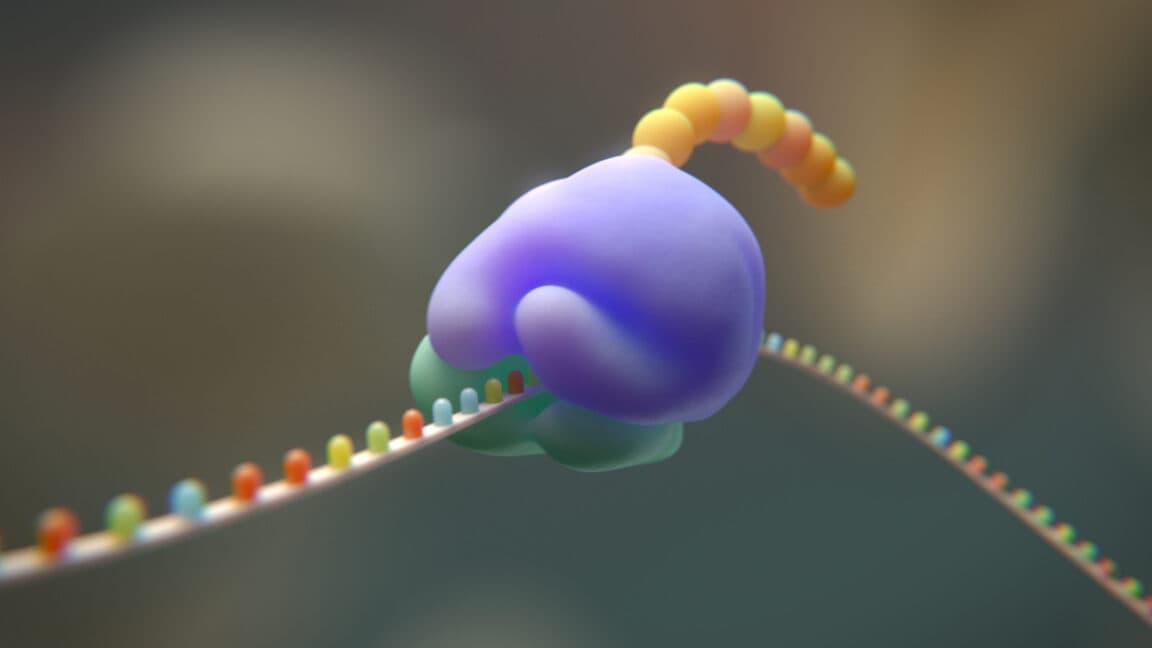
Researchers have successfully redesigned a crucial component of cellular machinery to work with one fewer amino acid. This breakthrough could pave the way for advancements in synthetic biology and engineered organisms.
Published in April 2026, the study utilized AI tools to modify part of the ribosome—the cell’s protein-making machine—allowing it to function without one of the 20 amino acids that all known life on Earth has depended on for billions of years. Think of amino acids as letters in an alphabet. Every living organism has been using the same 20-letter alphabet since life began. This experiment aims to demonstrate that, theoretically, you could manage with just 19.
Why Does the Genetic Code Use 20 Amino Acids?
DNA, life’s instruction manual, encodes proteins by linking amino acids in specific sequences. These proteins are responsible for almost everything in your body, from transporting oxygen in your blood to combating viruses. The 20-amino-acid system isn’t a predetermined rule; it evolved from our earliest common ancestor and has been maintained in nearly every organism since.
Scientists have long pondered whether this number is unique or merely a historical coincidence. Can life function with fewer? Or with more? Synthetic biologists have already introduced new, artificial amino acids into the mix, granting engineered proteins new abilities that nature never produced. But removing one amino acid is a more complex and unusual challenge.
How AI Helped in Redesigning the Ribosome
The ribosome is among the most intricate machines in biology. It interprets genetic instructions and assembles amino acids into proteins, one by one. The challenge with removing an amino acid from the code is that the ribosome and many other cellular components are designed to work with all 20. Altering even one part can disrupt the entire system.
That’s where AI comes in. The research team utilized AI-assisted protein design tools to determine how to adjust the ribosome’s structure so it could still operate without that specific amino acid. The AI tools, akin to the protein-folding software AlphaFold, helped the researchers model which modifications would keep the machinery functional under new constraints.
The outcome was a modified ribosome capable of constructing proteins without that 19th amino acid, at least in lab conditions.
Implications of This Research
For most people, this won’t change daily life anytime soon. However, the long-term implications are significant.
First, it proves that the 20-amino-acid genetic code isn’t set in stone. Life—or at least engineered versions of it—can be rebuilt using a different set of rules. This is huge for synthetic biology, where researchers aim to design organisms that can produce medicines, fuels, or materials that natural biology can’t efficiently create.
Second, a living system using only 19 amino acids would be fundamentally incompatible with standard biology. This is actually beneficial. If you’re engineering bacteria to produce a drug inside a person, you want a failsafe to prevent those bacteria from exchanging genes with naturally occurring microbes. An organism that operates on a different genetic alphabet would be biologically isolated, creating a natural containment mechanism.
Lastly, this research offers scientists a new approach to studying how life’s core systems evolved. If you can remove a part of the machinery and observe how the system adapts, you gain insights into how that machinery was originally constructed.
Community Response
“This is one of the most fascinating biology papers I’ve seen this year. The fact that they used AI design tools to rebuild the ribosome is wild. We’re using one engineered system to redesign another.”
— u/ProteinFoldingNerd, r/biology
“The containment aspect is what intrigues me. We’ve been concerned about GMO gene flow for decades. An organism that literally can’t share its code with normal life because it speaks a different biochemical language? That’s significant.”
— u/SynBioWatcher, r/genetics
| By The Numbers | |
|---|---|
| Standard amino acids in all known life | 20 |
| Target amino acid count in new system | 19 |
| Years since this 20-amino-acid code was established | ~3.5 billion |
| Word count of original Ars Technica report | 1,822 |
| Key tool used in redesign | AI protein design software |
The Bigger Picture for Synthetic Biology
This experiment is part of a wider movement to treat biology as programmable. Companies like Ginkgo Bioworks and academic labs around the world are striving to make living systems more predictable and controllable. Essentially, they aim to transform cells into factories that can be fine-tuned like software.
Reducing the amino acid alphabet is somewhat like moving from a 26-letter English alphabet to a 25-letter one and then proving you can still write a functioning novel. It might not be immediately clear why you’d want to do this, but showing that it’s possible changes the perspective on what engineers can achieve with biology.
The work received extensive coverage from Ars Technica, which highlighted that AI tools were crucial in making the ribosome redesign feasible. Without them, the number of structural changes to explore would have been overwhelmingly vast.
What To Watch
- Can the modified organism survive and replicate? Showing that a 19-amino-acid ribosome works in isolation is one thing. Building a complete, self-sustaining organism around it is the next major challenge researchers will face.
- Will other amino acids be targeted next? If one can be removed, the next question is whether two can be removed. Scientists will likely investigate the minimum viable amino acid set in future studies.
- Regulatory attention is coming. As synthetic biology tools advance, expect regulators in the US and EU to start drafting frameworks for organisms with non-standard genetic codes. That conversation is just beginning but already in motion.
- AI’s role will expand. This experiment is a prime example of AI being used not just to analyze biology but to actively redesign it. Look for more studies in 2026 and 2027 where AI-assisted protein design takes center stage rather than being a supporting tool.

Ava Mitchell
Ava Mitchell is a digital culture journalist at Explosion.com covering social media platforms, streaming services, and the creator economy. With 4 years reporting on TikTok, Instagram, YouTube, and the apps that shape daily life, Ava specializes in explaining platform policy changes and their impact on everyday users. She previously managed social media strategy for a tech startup, giving her firsthand experience with the platforms she now covers.