NASA is gearing up to deliver high-definition video coverage for its upcoming Artemis II Moon mission. They’re using a laser-based communications system that could change how we watch space exploration unfold in real time.
What’s Actually Changing
The Apollo missions gave us grainy black-and-white footage that, while historic, looked like it was shot through a fogged-up window. In contrast, the Artemis II mission — NASA’s first crewed Moon mission in over 50 years — aims to stream high-definition video from lunar orbit back to Earth.
This leap in technology relies on optical communications, or laser communications. You can think of it as upgrading from a garden hose to a fire hose. Traditional deep-space radio signals (RF, or radio frequency) can only transmit limited data. In contrast, laser-based systems direct a focused beam of light between a spacecraft and a ground station, allowing for much more data transfer per second — it’s like going from dial-up internet to fiber broadband, but over hundreds of thousands of miles of space.
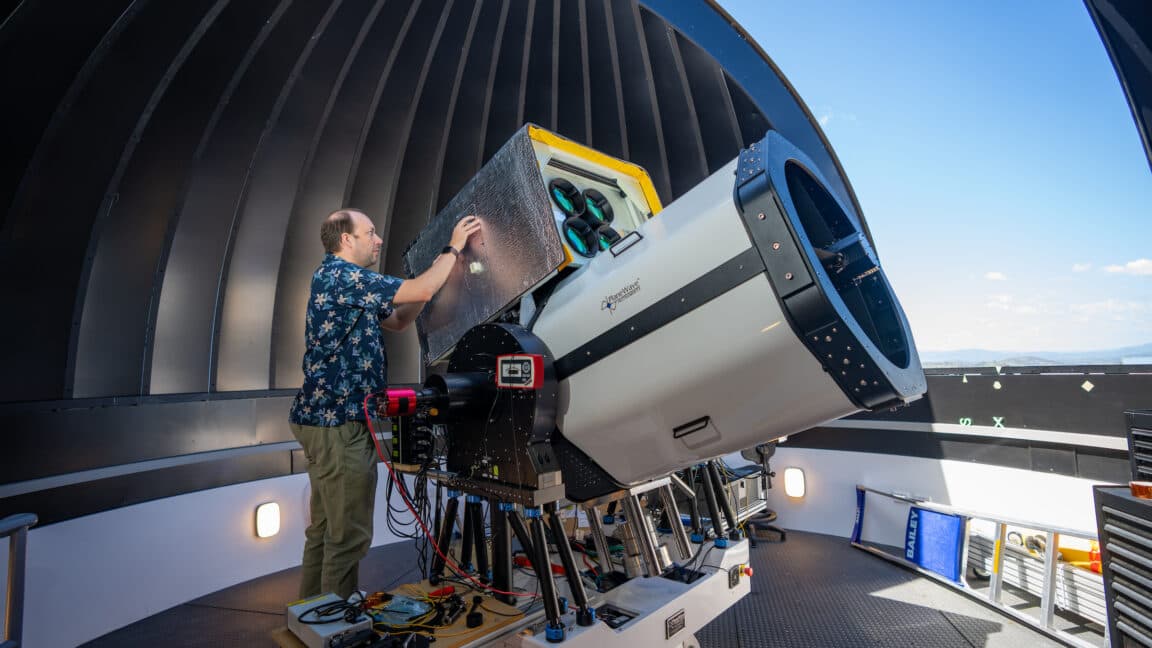
According to Ars Technica, the system is surprisingly easy to operate. One engineer noted, “You just push this button, and in three hours, you’re counting photons.” Those photons — the tiny particles of light — carry the video signal back home.
Why This Hasn’t Happened Before
Making laser communications work reliably in space is quite a challenge. A laser beam is very narrow, meaning that the transmitter on the spacecraft and the receiver on the ground must be perfectly aligned. This is tricky because the spacecraft moves at thousands of miles per hour while Earth rotates underneath it. It’s similar to trying to shine a flashlight through a pinhole from across a football field, all while both you and the pinhole are constantly moving.
NASA has tested this technology on smaller missions. The agency’s LLCD (Lunar Laser Communication Demonstration) experiment in 2013 proved the concept could work. More recently, the LCRD (Laser Communications Relay Demonstration) satellite has validated the technology in Earth orbit. Artemis II will mark the first time laser comms are used on a crewed mission at lunar distances.
What Artemis II Actually Is
Artemis II is NASA’s second Artemis mission overall, and the first with astronauts aboard. The crew of four — three Americans and one Canadian — will fly around the Moon without landing. This mission acts as a test run for the systems that a future landing mission will rely on. It’s currently targeted for 2026, though NASA has shifted schedules before.
| Detail | Data |
|---|---|
| Crew size | 4 astronauts |
| Mission type | Crewed lunar flyby (no landing) |
| Target launch year | 2026 |
| Distance to Moon (average) | ~239,000 miles |
| Original Apollo TV quality | Standard definition, black and white |
| Artemis II target video quality | High-definition (HD) |
| Comms technology | Laser / optical communications |
What This Means
For viewers, this means a more engaging experience: if everything goes according to plan, watching Artemis II could feel like a live sports broadcast. You’ll see HD video, clear images of the crew, the Moon’s surface from orbit, and Earth in the background — all in the quality you expect from your streaming service at home.
But it’s not just about the visuals. Clearer video has real scientific and operational benefits. Better footage helps engineers on Earth monitor equipment and identify issues more quickly. High-bandwidth comms also mean larger data files — like scientific readings, medical telemetry from the crew, and technical system logs — can be sent home much faster.
Nasa is also considering how this affects public engagement. The Apollo missions captivated audiences partly because of the footage, even when it was limited. High-quality coverage of Artemis could enhance how the public connects with the program, especially as NASA competes for attention and budget support.
Community Reactions
“Imagine watching a Moon mission in 4K on your TV. The Apollo footage was incredible despite being grainy — this could be a completely different level of experience.”
“The laser comm stuff is genuinely exciting from an engineering standpoint. Pointing accuracy at those distances is absurd. Really impressive if they pull it off on a crewed mission.”
What To Watch
- Artemis II launch window (2026): NASA hasn’t set a firm launch date yet, but 2026 is the current target. Any updates will come through NASA’s official Artemis program announcements.
- Ground station readiness: Laser communications need specially equipped ground stations. Keep an eye out for NASA updates on which facilities will support the Artemis II optical link.
- Pre-launch technology demos: NASA may share test results from its existing laser comm satellites (LCRD) before the mission to build public confidence in the system.
- Artemis III planning: If laser comms succeed on Artemis II, the technology will likely be key for Artemis III — the mission that would actually land humans on the Moon.

Daniel Park
Daniel Park covers AI, cloud infrastructure, and enterprise software for Explosion.com. A former software engineer who transitioned to technology journalism 5 years ago, Daniel brings technical depth to his reporting on artificial intelligence, startup funding rounds, and the companies building the future of computing. He breaks down complex AI developments and business strategies into clear, actionable insights for readers who want to understand how technology is reshaping industries.