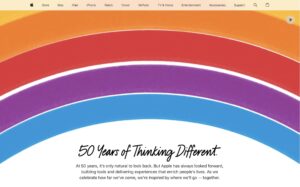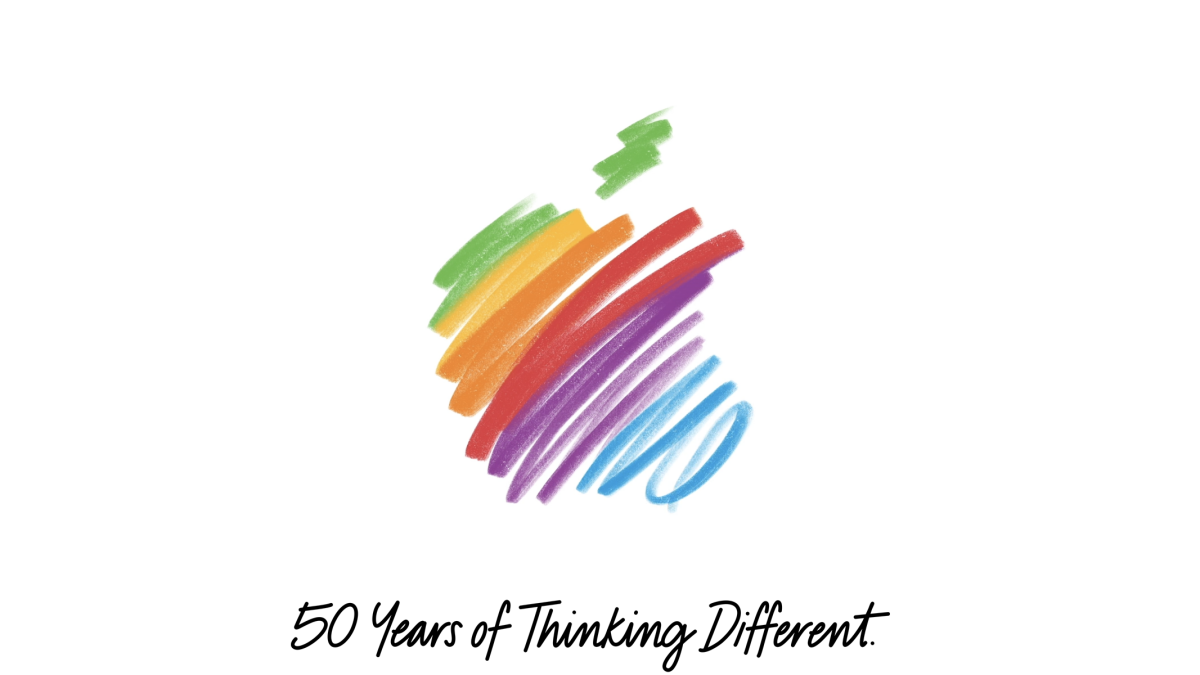
Today, Apple Inc. celebrates its 50th anniversary. From its humble beginnings in a California garage, the company now boasts a market cap of about $3.8 trillion. To mark this milestone, Apple has launched a special homepage animation and a wave of retrospective coverage.
| Apple Inc. — By The Numbers | |
|---|---|
| Founded | April 1, 1976 |
| Ticker | AAPL |
| Stock Price | $254.52 (+0.29%) |
| Market Cap | ~$3.8 Trillion |
| CEO | Tim Cook |
| Headquarters | Cupertino, CA |
| Sector | Big Tech |
A Birthday Surprise on Apple.com
If you check out apple.com today, you’ll notice something different. Instead of the usual product grid, Apple has swapped it for a fun animated short celebrating its 50 years. It’s like a two-minute highlight reel that plays right in your browser. Mashable was one of the first to point out the animation, calling it a “cute surprise” for visitors today.
Apple typically doesn’t dwell on the past. Instead, the company usually focuses on future innovations. So, dedicating its homepage to a nostalgic look back highlights how significant this anniversary is for Cupertino.
From Garage to $3.8 Trillion
Founded on April 1, 1976, by Steve Jobs, Steve Wozniak, and Ronald Wayne, Apple started with Wozniak’s hobby project, the Apple I. Jobs saw potential in it as a business. Wayne, however, sold his 10% share for just $800 a mere 12 days after signing the founding papers. That stake would be worth billions today.
You can break down Apple’s first 50 years into several key phases: the personal computer boom in the late 1970s and 1980s, a near-collapse in the mid-1990s, Jobs’ comeback with the iPod starting in 2001, the smartphone revolution with the iPhone in 2007, and the services and wearables empire that Tim Cook has built since Jobs passed away in 2011.
As CNET highlights in its anniversary retrospective, Apple hasn’t just entered various industries; it has transformed them. Personal computing, music distribution, mobile phones, tablets, wireless earbuds, and smartwatches all underwent major changes because of Apple.
The Moves That Actually Mattered
The Macintosh (1984)
The Macintosh introduced many consumers to the graphical user interface (GUI), which replaced text commands with a visual system of windows, icons, and a mouse pointer. Before the Mac, using a computer required memorizing text commands. After its launch, users could simply click on things.
The iPod and iTunes (2001–2003)
The iPod wasn’t the first digital music player, but it made listening to music incredibly easy. Combined with the iTunes Store in 2003, it changed how people bought music. It marked the end of the album-sales era and shifted consumers toward purchasing individual songs for 99 cents, eventually leading to the streaming model we know today.
The iPhone (2007)
When Jobs introduced the iPhone as “an iPod, a phone, and an internet communicator” in one device, he was spot on. The smartphone category existed before the iPhone, but it was mostly for business users with physical keyboards. The iPhone turned the touchscreen smartphone into a must-have device for billions.
The App Store (2008)
The App Store created a brand-new economy. Developers could build and sell software directly to iPhone users, bypassing traditional retailers. This model has generated over $1 trillion in developer earnings since its launch. It also gave Apple a competitive edge — and a regulatory challenge — that the company is still navigating.
What This Means for Everyday Users
If you own an iPhone, a Mac, AirPods, or an Apple Watch, you’re experiencing the result of 50 years of innovation from Cupertino. Apple’s design philosophy emphasizes a seamless integration of hardware, software, and services. This approach has become so ingrained in our expectations that we often forget it was once a controversial decision. Competitors have argued that Apple’s closed ecosystem would falter against more open systems. Yet, in terms of revenue and customer loyalty, Apple has proven them wrong.
So, what does the next 50 years hold? Apple Intelligence, the company’s brand for its AI features, began rolling out in late 2024. Whether this will lead to the next big shift like the iPhone or just be a footnote remains to be seen.
9to5Mac is offering a full series of anniversary coverage throughout the day if you’re interested in delving deeper into any specific era.
What People Are Saying
“Say what you want about Apple but the fact that a company founded literally as a hobby project is now worth more than the GDP of Germany is genuinely insane to think about.”
“The iPod era is still the most nostalgic tech period for me. That click wheel was perfect. Nothing since has felt that satisfying to use.”
What To Watch
- WWDC 2026 (expected June): This annual developer conference is where Apple usually previews upcoming versions of iOS, macOS, and its AI features. With the anniversary around the corner, expect an especially forward-looking keynote.
- Apple Intelligence expansion: Apple’s AI features are gradually rolling out. In the coming months, we should see wider availability and new capabilities, signaling how seriously the company is competing with Google and OpenAI.
- Regulatory outcomes: Antitrust cases concerning the App Store in the US and EU are still working their way through courts. Major rulings could force Apple to change its developer fees, impacting app prices and availability for users.
- Anniversary coverage: 9to5Mac, CNET, and other media are publishing in-depth retrospectives throughout the day. If you want to explore a specific Apple era, today’s a perfect opportunity.