





<div>
<p>The term &#8220;cockroach&#8221; is derived from the Spanish word &#8220;cucaracha,&#8221; which translates to &#8220;an insect that shines the light.&#8221; This etymology reflects the shiny exoskeleton of the cockroach, a physical characteristic that is easily observable. Although the exact reasons behind this naming tradition are not definitively known, the Spanish term evolved into the English &#8220;cockroach&#8221; over time and has been used for centuries to refer to this resilient insect.</p>
<!-- WP QUADS Content Ad Plugin v. 2.0.99 -->
<div class="quads-location quads-ad135805 " id="quads-ad135805" style="float:none;text-align:center;padding:0px 0 0px 0;" data-lazydelay="3000">

</div>

<p><img src="https://www.explosion.com/wp-content/uploads/2023/12/v2-4ooqr-77aj4.jpg" alt="" /></p>
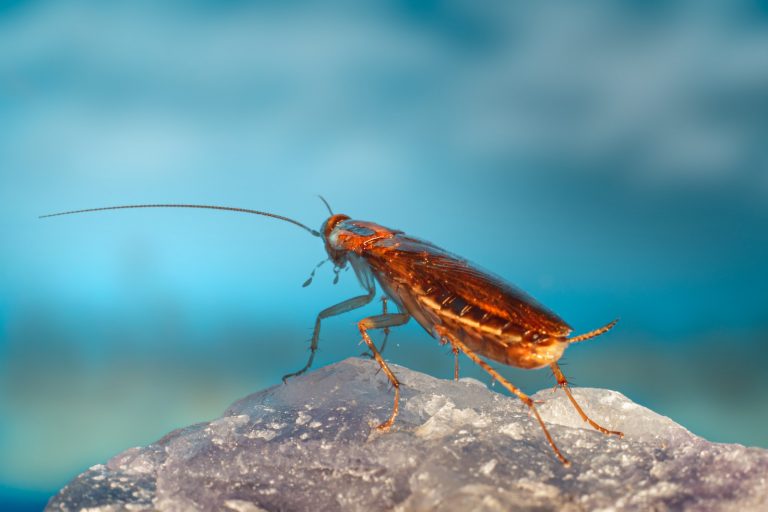
<p>Cockroaches belong to an ancient lineage, with ancestors originating during the Carboniferous period around 320 million years ago. These modern pests are noted for their adaptability to various environments and their capacity to survive in harsh conditions. With a flat, oval body, long antennae, and sometimes dark-colored exterior, cockroaches are recognized for their quick movements and their notorious association with human habitats.</p>
<p>Although often vilified for their pervasive presence and potential to invade personal spaces, cockroaches play a role in the ecosystem. They contribute to the decomposition process and nutrient cycle, albeit their reputation mostly centers on their status as pests due to their attraction to food, warmth, and moisture in human dwellings.</p>
<!-- WP QUADS Content Ad Plugin v. 2.0.99 -->
<div class="quads-location quads-ad135804 " id="quads-ad135804" style="float:none;text-align:center;padding:0px 0 0px 0;" data-lazydelay="3000">

</div>

<p>Let&#8217;s take a look at why is a cockroach called a cockroach.</p>
</div>
<div>
<h2>Etymology and Naming</h2>
<p><img src="https://www.explosion.com/wp-content/uploads/2023/12/v2-4oora-zmblf.jpg" alt="" /></p>
<p>The origin of the term &#8220;cockroach&#8221; reflects its entomological journey from Spanish to English. This section examines the term’s roots, its linguistic evolution, and its contemporary references.</p>
<h3>Historical Roots</h3>
<p>The term &#8220;cockroach&#8221; originated from the Spanish word <strong>&#8220;cucaracha&#8221;</strong>. Historically, the Spanish noun derives from the Latin <em>blatta</em>, denoting an insect that avoids light. It is hypothesized that <strong>cucaracha</strong> likely referred to an insect&#8217;s shiny appearance.</p>
<!-- WP QUADS Content Ad Plugin v. 2.0.99 -->
<div class="quads-location quads-ad135804 " id="quads-ad135804" style="float:none;text-align:center;padding:0px 0 0px 0;" data-lazydelay="3000">

</div>

<h3>Linguistic Journey</h3>
<p>By the 1620s, <strong>&#8220;cucaracha&#8221;</strong> transformed into <strong>&#8220;cockroach&#8221;</strong> in the English language, twisting the original pronunciation and meaning. Despite the transformation, the term retained its insectile reference. The <strong>etymology</strong> reflects a blend of cultures and languages illustrating the interaction between Spanish explorers and English speakers.</p>
<h3>Modern Usage</h3>
<p>In modern English, the term has been shortened to <strong>&#8220;roach&#8221;</strong> in casual and slang use. Additionally, regional terms like <strong>&#8220;palmetto bug&#8221;</strong> in the southeastern United States refer to certain large species of cockroach. The word <strong>&#8220;cockroach&#8221;</strong> itself has become a staple in the entomological lexicon, consistently used in both scientific contexts and everyday language.</p>
</div>
<div>
<h2>Biological Classification</h2>
<p><img src="https://www.explosion.com/wp-content/uploads/2023/12/v2-4oort-ka4hh.jpg" alt="" /></p>
<p>The classification of cockroaches is a detailed system that categorizes these insects within the animal kingdom based on their physical characteristics and genetic relationships. Now that we know why is a cockroach called a cockroach, we can talk more about this common insect.</p>
<!-- WP QUADS Content Ad Plugin v. 2.0.99 -->
<div class="quads-location quads-ad135804 " id="quads-ad135804" style="float:none;text-align:center;padding:0px 0 0px 0;" data-lazydelay="3000">

</div>

<h3>Taxonomic Rank</h3>
<p>Cockroaches belong to the <strong>phylum Arthropoda</strong>, which includes invertebrates with an exoskeleton, a segmented body, and jointed appendages. Specifically, cockroaches are classified within the <strong>class Insecta</strong>, marking them as insects. Within this class, they are further categorized into the <strong>order Blattodea</strong>, which recently has been found to include termites. The order Blattodea is part of the larger superorder <strong>Dictyoptera</strong>.</p>
<h3>Family and Species Diversity</h3>
<p>The diversity among cockroach species is extensive, with about 4,600 species identified so far. Notably, a few species are well-known globally due to their commonality and interactions with human habitats:</p>
<ul>
<li><strong>American Cockroach</strong> (<em>Periplaneta americana</em>): Characterized by their large size and reddish-brown color</li>
<li><strong>German Cockroach</strong> (<em>Blattella germanica</em>): Smaller and pale brown, known for their reproductive speed</li>
<li><strong>Oriental Cockroach</strong> (<em>Blatta orientalis</em>): Shiny black and known for their preference for damp environments</li>
</ul>
<p>These species differ significantly in habits, habitats, and adaptations, illustrating the vast diversification that has occurred within the order Blattodea.</p>
</div>
<div>
<h2>Morphology and Anatomy</h2>
<div></div>
<p>Cockroaches exhibit distinct physical characteristics and sensory abilities that have adapted over time to enable them to survive in various environments.</p>
<!-- WP QUADS Content Ad Plugin v. 2.0.99 -->
<div class="quads-location quads-ad135804 " id="quads-ad135804" style="float:none;text-align:center;padding:0px 0 0px 0;" data-lazydelay="3000">

</div>

<h3>Physical Features</h3>
<p>Cockroaches possess a <strong>flattened oval body</strong> that contributes to their ability to navigate and hide in narrow crevices. Their body is segmented into three primary parts: the <strong>head</strong>, <strong>thorax</strong>, and <strong>abdomen</strong>. The <strong>exoskeleton</strong> is robust and made up of <strong>sclerites</strong>, which are calcareous plates that provide both protection and structure. Typically, the exoskeleton exhibits a <strong>shining black or brown leathery integument</strong>, which assists in moisture retention and offers a camouflage advantage in their natural habitat.</p>
<ul>
<li><strong>Head</strong>: It is angled downward and carries a pair of <strong>compound eyes</strong> and two long, <strong>threadlike antennae</strong> that serve as tactile and olfactory sensory organs</li>
<li><strong>Thorax</strong>: This section is divided into three parts—Prothorax, Mesothorax, and Metathorax—each playing a role in locomotion</li>
<li><strong>Abdomen</strong>: Consisting of 10 segments, this area contains the reproductive and digestive systems of the cockroach</li>
</ul>
<p>The morphology of cockroaches reflects their adaptation through a durable structure capable of withstanding harsh conditions.</p>
<h3>Sensory Abilities</h3>
<p>Cockroaches are equipped with exceptional sensory abilities that enable them to detect changes in their environment, ensuring their survival.</p>
<ul>
<li><strong>Antennae</strong>: These function as sophisticated sensory organs that can detect a multitude of stimuli, such as touch, temperature, and odor</li>
<li><strong>Eyes</strong>: The <strong>compound eyes</strong> of a cockroach are designed to perceive movements and light changes, enabling them to evade threats effectively</li>
</ul>
<p>These sensory adaptations are key to the cockroach&#8217;s navigation and ability to find resources while avoiding predators.</p>
<!-- WP QUADS Content Ad Plugin v. 2.0.99 -->
<div class="quads-location quads-ad135804 " id="quads-ad135804" style="float:none;text-align:center;padding:0px 0 0px 0;" data-lazydelay="3000">

</div>

</div>
<div>
<h2>Reproduction and Development</h2>
<div></div>
<p>Cockroach reproduction and development involve distinct stages from egg to nymph to adult, with specialized egg cases facilitating the process. These vital aspects of their life cycle exhibit considerable diversity across species.</p>
<h3>Reproductive Cycle</h3>
<p>Female cockroaches produce eggs that are often encased in a protective structure called an <strong>ootheca</strong>. They typically lay their oothecae in warm, moist environments conducive to the eggs&#8217; development. The <strong>ovipositor</strong>, an organ in female cockroaches, is instrumental in positioning the ootheca in a secure location. Reproduction generally begins with the female emitting pheromones to attract a male; once successful, males deposit sperm into the female for fertilization.</p>
<ol>
<li><strong>Mating</strong>: Involves pheromone communication and can include male competition</li>
<li><strong>Egg Production</strong>: The female uses her ovipositor to lay eggs within an ootheca</li>
<li><strong>Ootheca</strong>: A hard, protective case that typically contains multiple eggs. It is often conspicuous and deposited in a secure, concealed location</li>
</ol>
<h3>Growth Stages</h3>
<p>After eggs hatch, cockroaches emerge as <strong>nymphs</strong> — smaller, wingless versions of adults. These nymphs undergo a series of molts, shedding their exoskeleton as they grow larger. Each molt, known as an <strong>instar</strong>, brings them closer to their final adult form. The transition from nymph to adult involves significant physiological changes where wings and reproductive capabilities develop.</p>
<ul>
<li><strong>Nymphs</strong>: Juvenile stages that progressively molt to reach adulthood</li>
<li><strong>Life Cycle</strong>: Multiple nymphal stages (instars) before reaching maturity</li>
<li><strong>Adult</strong>: Final stage capable of reproduction</li>
</ul>
<p>Different species of cockroaches may have variations in their reproductive techniques and developmental timelines, yet the general pattern of external egg development and gradual nymph growth is a common thread throughout the cockroach family.</p>
<!-- WP QUADS Content Ad Plugin v. 2.0.99 -->
<div class="quads-location quads-ad135804 " id="quads-ad135804" style="float:none;text-align:center;padding:0px 0 0px 0;" data-lazydelay="3000">

</div>

</div>
<div>
<h2>Behavioral Traits</h2>
<p><img src="https://www.explosion.com/wp-content/uploads/2023/12/v2-4oouy-5y9ye.jpg" alt="" /></p>
<p>Cockroaches are known for their remarkable survival skills and adaptable feeding habits, which have been key to their persistence through the ages.</p>
<h3>Survival Strategies</h3>
<p>Cockroaches exhibit a high level of <strong>resilience</strong> due to their ability to tolerate various environments. They possess an arsenal of survival strategies that make them formidable occupants of their ecosystems. Their capacity for <strong>detoxification</strong> allows them to survive on toxic or spoiled substances, while their rapid reproduction rate ensures their species thrives even when faced with numerous <strong>predators</strong>. When threatened, cockroaches rely on their swift <strong>escape</strong> reflexes, often hiding in small crevices that are inaccessible to larger threats.</p>
<h3>Feeding Habits</h3>
<p>These insects are <strong>scavengers</strong>, with a <strong>diet</strong> that is incredibly diverse, allowing them to capitalize on a wide range of organic <strong>food</strong> sources. They typically feed on decaying matter, which includes anything from leftover human food to dead plants and animals. Their feeding habits play a significant role in the ecosystem by contributing to the process of <strong>detoxification</strong> and nutrient recycling. Their <strong>behavior</strong> as scavengers is fundamental to their ecological importance, as they help clean up waste contributing to a balanced environment.</p>
<!-- WP QUADS Content Ad Plugin v. 2.0.99 -->
<div class="quads-location quads-ad135804 " id="quads-ad135804" style="float:none;text-align:center;padding:0px 0 0px 0;" data-lazydelay="3000">

</div>

</div>
<div>
<h2>Cockroach Habitat and Distribution</h2>
<p><img src="https://www.explosion.com/wp-content/uploads/2023/12/v2-4oovi-202ai.jpg" alt="" /></p>
<p>Cockroaches are highly adaptable insects that thrive in various environments, though they have a preference for warm conditions. Their vast distribution includes multiple continents, with significant populations in tropical regions.</p>
<h3>Preferred Environments</h3>
<p><strong>Climates</strong>: Cockroaches are versatile and can inhabit a range of climates. They have a marked preference for <strong>warm temperatures</strong>, which supports their physiological processes.</p>
<p><strong>Habitats</strong>: These insects are particularly fond of dark, moist environments, where they can find food and protection. <strong>Basements</strong> and kitchen areas offer ideal conditions for cockroaches, providing warmth, moisture, and potential food sources.</p>
<!-- WP QUADS Content Ad Plugin v. 2.0.99 -->
<div class="quads-location quads-ad135804 " id="quads-ad135804" style="float:none;text-align:center;padding:0px 0 0px 0;" data-lazydelay="3000">

</div>

<h3>Geographical Presence</h3>
<p><strong>Tropical Regions</strong>: A significant portion of the cockroach population is found in <strong>tropical</strong> areas, where humidity and heat are consistent year-round.</p>
<ul>
<li><strong>Africa</strong>: Many species of cockroaches are native to the African continent, taking advantage of the tropical climates available in many regions</li>
<li><strong>Middle East</strong>: Similarly, the Middle East, with its warm climate, is home to a variety of cockroach species</li>
</ul>
<p>The geographical spread of cockroaches is not limited by many environmental constraints, demonstrating their exceptional capacity to adapt to and colonize new environments.</p>
</div>
<div>
<h2>Pest Status and Impact</h2>
<p><img src="https://www.explosion.com/wp-content/uploads/2023/12/v2-4oow2-f59ks.jpg" alt="" /></p>
<p>Cockroaches are among the most prevalent and resilient household pests, creating significant infestations that can be challenging to control. They adapt easily to a variety of environments but thrive in the warm conditions of homes, where they have easy access to food and water.</p>
<!-- WP QUADS Content Ad Plugin v. 2.0.99 -->
<div class="quads-location quads-ad135804 " id="quads-ad135804" style="float:none;text-align:center;padding:0px 0 0px 0;" data-lazydelay="3000">

</div>

<h3>Home Infestations</h3>
<p>Cockroach infestations can swiftly escalate due to their rapid breeding cycles and elusive nature. They are nocturnal creatures, preferring to hide in dark, secluded areas during the day and emerging at night to feed. The presence of cockroaches is not only a nuisance but can also indicate an underlying issue with home sanitation and maintenance. <strong>Pest control</strong> measures must be taken seriously to manage a cockroach infestation effectively. Common signs of an infestation include seeing roaches during the day, finding their droppings, or noticing an oily or musty smell.</p>
<h3>Economic and Health Concerns</h3>
<p>Compounding their status as a nuisance, cockroaches pose various economic and health concerns. They are known to contaminate food and surfaces, spreading bacteria and pathogens which can lead to illnesses such as salmonella, gastroenteritis, and allergies. The cost of extermination and ongoing <strong>pest control</strong> efforts, as well as food spoilage and property damage, contribute to their economic impact.</p>
<table>
<thead>
<tr>
<th>Concern</th>
<th>Details</th>
</tr>
</thead>
<tbody>
<tr>
<td>Contamination</td>
<td>Spread bacteria and allergens leading to diseases</td>
</tr>
<tr>
<td>Property Damage</td>
<td>Chew on materials, damage wallpapers, books</td>
</tr>
<tr>
<td>Allergies</td>
<td>Cockroach droppings and shed skin can trigger asthma and allergies</td>
</tr>
<tr>
<td>Pest Control</td>
<td>Continuous effort and expense required to manage infestations</td>
</tr>
</tbody>
</table>
<p>Infestations require knowledgeable pest control strategies, as cockroaches have developed resistance to many common insecticides, further emphasizing their capacity as a disruptive pest.</p>
</div>
<div>
<h2>Cultural and Historical Significance</h2>
<p><img src="https://www.explosion.com/wp-content/uploads/2023/12/v2-4oox5-g1715.jpg" alt="" /></p>
<!-- WP QUADS Content Ad Plugin v. 2.0.99 -->
<div class="quads-location quads-ad135804 " id="quads-ad135804" style="float:none;text-align:center;padding:0px 0 0px 0;" data-lazydelay="3000">

</div>

<p>The cultural and historical significance of cockroaches stretches back to ancient times and has been reflected in various media and literature, shaping the modern perception of this resilient insect.</p>
<h3>Ancient and Modern Perceptions</h3>
<p>Historically, the cockroach has had a presence that dates back to the <strong>Carboniferous era</strong>, over 320 million years ago. Fossils from this period evidence the existence of their ancestors, &#8220;roachoids,&#8221; which differed from modern cockroaches. <strong>In the 17th century</strong>, the term &#8220;cockroach&#8221; emerged from the Spanish word &#8220;cucaracha,&#8221; assimilating into the English language and evolving to represent the insects known today.</p>
<p>Modern cockroaches, despite sharing a lineage with ancient fossils, are often viewed negatively due to their association with filth and decay. This perception is prominent across various cultures, solidifying the cockroach&#8217;s notorious reputation as a pest throughout history.</p>
<h3>Cockroaches in Media and Literature</h3>
<p>Cockroaches have frequently found their way into media and literature, utilized by authors and filmmakers to elicit a reaction or convey a message.</p>
<!-- WP QUADS Content Ad Plugin v. 2.0.99 -->
<div class="quads-location quads-ad135804 " id="quads-ad135804" style="float:none;text-align:center;padding:0px 0 0px 0;" data-lazydelay="3000">

</div>

<ul>
<li><strong>Books</strong>: Cockroaches appear in books ranging from scientific texts that document their behavior and evolution to fictional works that use them metaphorically to address themes such as survival and resilience</li>
<li><strong>Modern References</strong>: In recent media, cockroaches are more than just characters; they often symbolize the perseverance of life, given their famed ability to survive in harsh conditions</li>
</ul>
<p>This engagement with the cockroach in various forms of storytelling underscores its ongoing cultural relevance and impact.</p>
</div>
<div>
<h2>Control and Eradication Methods</h2>
<p><img src="https://www.explosion.com/wp-content/uploads/2023/12/v2-4ooxr-380aq.jpg" alt="" /></p>
<p>Effective cockroach control and eradication strategies include a combination of chemical and natural methods. These approaches are aimed at disrupting the cockroach lifecycle and deterring future infestations.</p>
<h3>Chemical Approaches</h3>
<p><strong>Insecticides</strong> are a common and powerful tool used to combat cockroach populations. For domestic use, the options include:</p>
<!-- WP QUADS Content Ad Plugin v. 2.0.99 -->
<div class="quads-location quads-ad135804 " id="quads-ad135804" style="float:none;text-align:center;padding:0px 0 0px 0;" data-lazydelay="3000">

</div>

<ul>
<li><strong>Baits:</strong> Typically contain a slow-acting poison mixed with a food attractant, intended to be carried back to the nest</li>
<li><strong>Sprays:</strong> Fast-acting aerosols that kill cockroaches on contact, often used for immediate relief</li>
<li><strong>Gels:</strong> Applied in small dots along areas of cockroach traffic, gels are consumed by cockroaches and can also be effective in killing at the nest level</li>
<li><strong>Insect Growth Regulators (IGRs):</strong> These chemicals interfere with the cockroach&#8217;s development, preventing them from reaching maturity or reproducing</li>
</ul>
<p>It is critical to follow all label instructions for safe and effective usage of insecticides, keeping in mind that many cockroach species can develop resistance to common chemicals.</p>
<h3>Natural Remedies</h3>
<p>For those seeking non-chemical methods, several <strong>home remedies</strong> have proven to be effective:</p>
<ul>
<li><strong>Diatomaceous Earth (DE):</strong> A fine powder that damages the cockroach&#8217;s exoskeleton, leading to dehydration</li>
<li><strong>Boric Acid:</strong> A substance commonly used in powder form that can be fatal to cockroaches upon ingestion</li>
<li><strong>Essential Oils:</strong> Some oils, like peppermint, can act as repellents due to their strong scent</li>
</ul>
<p>When implementing natural remedies, placement is crucial; ensuring the substances are in the path of the cockroaches without posing risks to pets or children. Regular cleaning and maintenance of potential food sources and entry points complement these efforts.</p>
</div>
</p>
<div class="essb_links essb_counter_modern_right essb_displayed_bottom essb_share essb_template_default4-retina essb_255986182 print-no" id="essb_displayed_bottom_255986182" data-essb-postid="146330" data-essb-position="bottom" data-essb-button-style="button" data-essb-template="default4-retina" data-essb-counter-pos="right" data-essb-url="https://www.explosion.com/146330/why-is-a-cockroach-called-a-cockroach/" data-essb-fullurl="https://www.explosion.com/146330/why-is-a-cockroach-called-a-cockroach/" data-essb-instance="255986182"><ul class="essb_links_list"><li class="essb_item essb_link_facebook nolightbox essb_link_svg_icon"> <a href="https://www.facebook.com/sharer/sharer.php?u=https%3A%2F%2Fwww.explosion.com%2F146330%2Fwhy-is-a-cockroach-called-a-cockroach%2F&t=Why+is+a+Cockroach+Called+a+Cockroach%3A+Origins+of+the+Common+Insect%5C%26%23039%3Bs+Name" title="Share on Share" onclick="essb.window(&#39;https://www.facebook.com/sharer/sharer.php?u=https%3A%2F%2Fwww.explosion.com%2F146330%2Fwhy-is-a-cockroach-called-a-cockroach%2F&t=Why+is+a+Cockroach+Called+a+Cockroach%3A+Origins+of+the+Common+Insect%5C%26%23039%3Bs+Name&#39;,&#39;facebook&#39;,&#39;255986182&#39;); return false;" target="_blank" rel="nofollow" class="nolightbox essb-s-bg-facebook essb-s-c-light essb-s-ch-light essb-s-bgh-dark essb-s-bg-network" ><span class="essb_icon essb_icon_facebook"><svg class="essb-svg-icon essb-svg-icon-facebook" aria-hidden="true" role="img" focusable="false" xmlns="http://www.w3.org/2000/svg" width="16" height="16" viewBox="0 0 16 16"><path d="M16 8.049c0-4.446-3.582-8.05-8-8.05C3.58 0-.002 3.603-.002 8.05c0 4.017 2.926 7.347 6.75 7.951v-5.625h-2.03V8.05H6.75V6.275c0-2.017 1.195-3.131 3.022-3.131.876 0 1.791.157 1.791.157v1.98h-1.009c-.993 0-1.303.621-1.303 1.258v1.51h2.218l-.354 2.326H9.25V16c3.824-.604 6.75-3.934 6.75-7.951"></path></svg></span><span class="essb_network_name">Share</span></a></li><li class="essb_item essb_link_twitter nolightbox essb_link_twitter_x essb_link_svg_icon"> <a href="https://x.com/intent/post?text=Why%20is%20a%20Cockroach%20Called%20a%20Cockroach%3A%20Origins%20of%20the%20Common%20Insect%27s%20Name&;url=https%3A%2F%2Fwww.explosion.com%2F146330%2Fwhy-is-a-cockroach-called-a-cockroach%2F" title="Share on Tweet" onclick="essb.window(&#39;https://x.com/intent/post?text=Why%20is%20a%20Cockroach%20Called%20a%20Cockroach%3A%20Origins%20of%20the%20Common%20Insect%27s%20Name&;url=https%3A%2F%2Fwww.explosion.com%2F146330%2Fwhy-is-a-cockroach-called-a-cockroach%2F&#39;,&#39;twitter&#39;,&#39;255986182&#39;); return false;" target="_blank" rel="nofollow" class="nolightbox essb-s-bg-twitter essb-s-c-light essb-s-ch-light essb-s-bgh-dark essb-s-bg-network" ><span class="essb_icon essb_icon_twitter_x"><svg class="essb-svg-icon essb-svg-icon-twitter_x" aria-hidden="true" role="img" focusable="false" viewBox="0 0 24 24"><path d="M18.244 2.25h3.308l-7.227 8.26 8.502 11.24H16.17l-5.214-6.817L4.99 21.75H1.68l7.73-8.835L1.254 2.25H8.08l4.713 6.231zm-1.161 17.52h1.833L7.084 4.126H5.117z"></path></svg></span><span class="essb_network_name">Tweet</span></a></li><li class="essb_item essb_link_pinterest nolightbox essb_link_svg_icon"> <a href="#" title="Share on Pin It" onclick="essb.pinterest_picker(&#39;255986182&#39;); return false;" target="_blank" rel="nofollow" class="nolightbox essb-s-bg-pinterest essb-s-c-light essb-s-ch-light essb-s-bgh-dark essb-s-bg-network" ><span class="essb_icon essb_icon_pinterest"><svg class="essb-svg-icon essb-svg-icon-pinterest" aria-hidden="true" role="img" focusable="false" width="32" height="32" viewBox="0 0 32 32" xmlns="http://www.w3.org/2000/svg"><path d="M10.625 12.25c0-1.375 0.313-2.5 1.063-3.438 0.688-0.938 1.563-1.438 2.563-1.438 0.813 0 1.438 0.25 1.875 0.813s0.688 1.25 0.688 2.063c0 0.5-0.125 1.125-0.313 1.813-0.188 0.75-0.375 1.625-0.688 2.563-0.313 1-0.563 1.75-0.688 2.313-0.25 1-0.063 1.875 0.563 2.625 0.625 0.688 1.438 1.063 2.438 1.063 1.75 0 3.188-1 4.313-2.938 1.125-2 1.688-4.375 1.688-7.188 0-2.125-0.688-3.875-2.063-5.25-1.375-1.313-3.313-2-5.813-2-2.813 0-5.063 0.875-6.75 2.688-1.75 1.75-2.625 3.875-2.625 6.375 0 1.5 0.438 2.75 1.25 3.75 0.313 0.313 0.375 0.688 0.313 1.063-0.125 0.313-0.25 0.813-0.375 1.5-0.063 0.25-0.188 0.438-0.375 0.5s-0.375 0.063-0.563 0c-1.313-0.563-2.25-1.438-2.938-2.75s-1-2.813-1-4.5c0-1.125 0.188-2.188 0.563-3.313s0.875-2.188 1.625-3.188c0.75-1.063 1.688-1.938 2.688-2.75 1.063-0.813 2.313-1.438 3.875-1.938 1.5-0.438 3.125-0.688 4.813-0.688 1.813 0 3.438 0.313 4.938 0.938 1.5 0.563 2.813 1.375 3.813 2.375 1.063 1.063 1.813 2.188 2.438 3.5 0.563 1.313 0.875 2.688 0.875 4.063 0 3.75-0.938 6.875-2.875 9.313-1.938 2.5-4.375 3.688-7.375 3.688-1 0-1.938-0.188-2.813-0.688-0.875-0.438-1.5-1-1.875-1.688-0.688 2.938-1.125 4.688-1.313 5.25-0.375 1.438-1.25 3.188-2.688 5.25h-1.313c-0.25-2.563-0.188-4.688 0.188-6.375l2.438-10.313c-0.375-0.813-0.563-1.813-0.563-3.063z"></path></svg></span><span class="essb_network_name">Pin It</span></a></li><li class="essb_item essb_link_mail nolightbox essb_link_svg_icon"> <a href="#" title="Share on Email" onclick="essb_open_mailform(&#39;255986182&#39;); return false;" target="_blank" rel="nofollow" class="nolightbox essb-s-bg-mail essb-s-c-light essb-s-ch-light essb-s-bgh-dark essb-s-bg-network" ><span class="essb_icon essb_icon_mail"><svg class="essb-svg-icon essb-svg-icon-mail" aria-hidden="true" role="img" focusable="false" width="32" height="32" xmlns="http://www.w3.org/2000/svg" viewBox="0 0 60 60"><polygon points="60,50.234 60,9.944 39.482,30.536 " /><polygon points="0,9.941 0,50.234 20.519,30.535 " /><path d="M1.387,8.5l21.002,21.08c0.121,0.051,0.471,0.415,0.517,0.519l5.941,5.963c0.635,0.591,1.672,0.59,2.333-0.025l5.911-5.933c0.046-0.105,0.4-0.473,0.522-0.524L58.615,8.5H1.387z" /><path d="M38.07,31.954l-5.5,5.52c-0.73,0.68-1.657,1.019-2.58,1.019c-0.914,0-1.823-0.332-2.533-0.993l-5.526-5.546L1.569,51.5h56.862L38.07,31.954z" /></svg></span><span class="essb_network_name">Email</span></a></li></ul></div>



0 Comments