



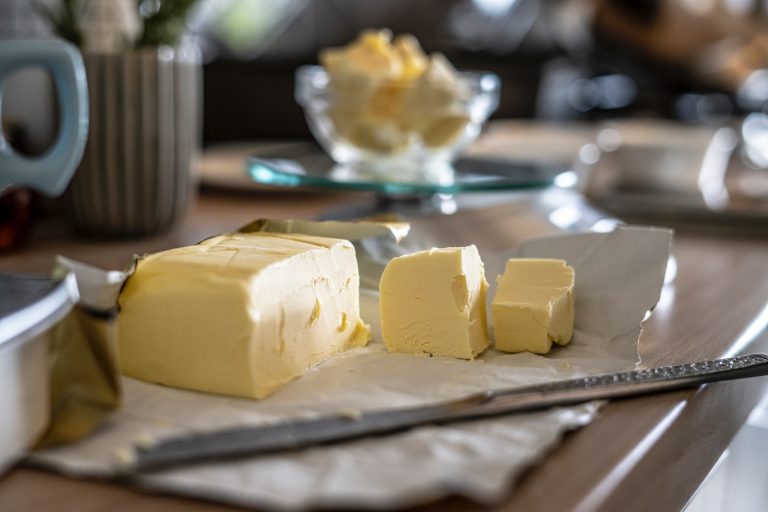


<p>Are you a baking enthusiast or a culinary aficionado who is looking to understand how much salt to add to unsalted butter? This guide is here to assist you. We&#8217;ll delve into the intricacies of the salt-to-butter ratio, the differences between salted and unsalted butter, and how to transform your unsalted butter into a salted variety with ease.</p>
<!-- WP QUADS Content Ad Plugin v. 2.0.99 -->
<div class="quads-location quads-ad135805 " id="quads-ad135805" style="float:none;text-align:center;padding:0px 0 0px 0;" data-lazydelay="3000">

</div>

<p>So, read on to find out about some essential kitchen tips. And feel free to use these tricks for your cookies, cakes, and other baking recipe goods.</p>
<h2>Understanding the Butter Basics</h2>
<p>Before we dive into the specifics of how much salt to add to unsalted butter, it&#8217;s essential to grasp a fundamental understanding of butter. Butter, a key ingredient in most baking recipes, comes in two main types: salted and unsalted.</p>
<p>Each type has its distinctive characteristics and uses. The choice between salted and unsalted butter often depends on the recipe and personal preference. However, at times, you might find yourself in a situation where a recipe calls for salted butter, but you only have unsalted butter at hand. This is where understanding the concept of adding salt to unsalted butter becomes essential.</p>
<!-- WP QUADS Content Ad Plugin v. 2.0.99 -->
<div class="quads-location quads-ad135804 " id="quads-ad135804" style="float:none;text-align:center;padding:0px 0 0px 0;" data-lazydelay="3000">

</div>

<h2>Salted vs Unsalted Butter: The Key Differences</h2>
<p>Salted and unsalted butter may appear the same, but they have a few noticeable differences. The most obvious one is the presence of salt. Salted butter contains salt, while unsalted butter doesn&#8217;t. This addition of salt impacts not only the taste but also the shelf life and texture of the butter. So let&#8217;s talk about the salted vs unsalted butter debate.</p>
<p><strong>Taste:</strong> Salt enhances the flavor of butter, offering a savory dimension that complements many dishes, especially baked goods. It balances the richness of butter, making it more enjoyable to the palate.</p>
<p><strong>Shelf Life:</strong> Salt acts as a natural preservative. Thus, salted butter tends to have a longer shelf life compared to its unsalted counterpart.</p>
<p><strong>Texture:</strong> The texture of both types of butter is usually the same unless larger salt crystals are used in salted butter, which may result in a slightly crunchy texture.</p>
<!-- WP QUADS Content Ad Plugin v. 2.0.99 -->
<div class="quads-location quads-ad135804 " id="quads-ad135804" style="float:none;text-align:center;padding:0px 0 0px 0;" data-lazydelay="3000">

</div>

<h2>Why Use Salted Butter?</h2>
<p>Salted butter is favored for several reasons. First, it provides a consistent level of saltiness, enhancing the overall flavor of the dishes. Second, thanks to its preservative properties, salted butter enjoys a longer shelf life, making it a practical choice for many households.</p>
<p>Moreover, salted butter is an excellent choice for dishes where butter is the star, such as in hand-held appetizers, homemade pancakes, or compound butters combined with herbs and spices.</p>
<h2>Can You Add Salt to Unsalted Butter?</h2>
<p>Yes, you can absolutely add salt to unsalted butter! This process allows you to control the exact amount of salt in your butter, ensuring a consistent and balanced flavor in your baking recipe.</p>
<p>However, to successfully transform your unsalted butter into salted butter, you need to follow a specific salt-to-butter ratio. The rule of thumb is to add ¼ teaspoon of salt for every 8 tablespoons (or ½ cup) of unsalted butter.</p>
<!-- WP QUADS Content Ad Plugin v. 2.0.99 -->
<div class="quads-location quads-ad135804 " id="quads-ad135804" style="float:none;text-align:center;padding:0px 0 0px 0;" data-lazydelay="3000">

</div>

<h2>How to Add Salt to Unsalted Butter?</h2>
<p>Transforming your unsalted butter into a salted variety involves a simple process. Here is a step-by-step guide:</p>
<p><strong>Optional Step &#8211; Melt the Butter:</strong> If you&#8217;re using larger salt crystals, you might consider melting the butter to ensure the salt is fully incorporated. Once melted, mix it again, then refrigerate until it hardens.</p>
<p><strong>Blend Well:</strong> Stir the mixture thoroughly until the salt is evenly distributed throughout the butter. Taste and add more salt if necessary.</p>
<p><strong>Add the Salt:</strong> Place the softened butter in a mixing bowl and add the appropriate amount of salt.</p>
<!-- WP QUADS Content Ad Plugin v. 2.0.99 -->
<div class="quads-location quads-ad135804 " id="quads-ad135804" style="float:none;text-align:center;padding:0px 0 0px 0;" data-lazydelay="3000">

</div>

<p><strong>Soften the Butter:</strong> Remove the butter from the refrigerator and let it soften at room temperature.</p>
<h2>Conversion Chart: Salt-to-Butter Measurements</h2>
<p>Here&#8217;s a handy conversion chart to guide you on how much salt to add to unsalted butter:</p>
<figure class="table">
<table>
<thead>
<tr>
<th><strong>Unsalted Butter</strong></th>
<th><strong>Amount of Salt Needed</strong></th>
</tr>
</thead>
<tbody>
<tr>
<td>2 tablespoons (25g)</td>
<td>1/16 teaspoon</td>
</tr>
<tr>
<td>4 tablespoons (50g)</td>
<td>1/8 teaspoon</td>
</tr>
<tr>
<td>8 tablespoons (100g)</td>
<td>1/4 teaspoon</td>
</tr>
<tr>
<td>16 tablespoons (200g)</td>
<td>1/2 teaspoon</td>
</tr>
</tbody>
</table>
</figure>
<p>Remember, these are just general guidelines. You might want to adjust the salt quantity based on your personal preference or specific dietary needs.</p>
<h2>Choosing the Right Type of Salt</h2>
<p>When it comes to choosing the type of salt to use, fine-grain salt is the best choice. This includes table salt or fine sea salt. Fine-grain salt dissolves easily in butter, ensuring a smooth texture.</p>
<!-- WP QUADS Content Ad Plugin v. 2.0.99 -->
<div class="quads-location quads-ad135804 " id="quads-ad135804" style="float:none;text-align:center;padding:0px 0 0px 0;" data-lazydelay="3000">

</div>

<p>On the other hand, larger salt crystals, like kosher or sea salt, might not dissolve as easily and could result in a slightly crunchy texture in the butter. While some might enjoy this texture, it&#8217;s not typically preferred in most recipes.</p>
<h2>How to Substitute Salted Butter with Unsalted Butter</h2>
<p>There might be situations where you only have salted butter on hand while your recipe calls for unsalted butter. In such cases, you must adjust the amount of salt in your recipe.</p>
<p>If a recipe requires unsalted butter and a certain amount of salt, just use your salted butter and reduce the salt quantity in the recipe by ¼ teaspoon for every 8 tablespoons of butter. For instance, if a recipe calls for 8 tablespoons of unsalted butter and ½ teaspoon of salt, just reduce the amount of salt to ¼ teaspoon and use your salted butter.</p>

<div class="essb_links essb_counter_modern_right essb_displayed_bottom essb_share essb_template_default4-retina essb_1726534013 print-no" id="essb_displayed_bottom_1726534013" data-essb-postid="143820" data-essb-position="bottom" data-essb-button-style="button" data-essb-template="default4-retina" data-essb-counter-pos="right" data-essb-url="https://www.explosion.com/143820/how-much-salt-to-add-to-unsalted-butter/" data-essb-fullurl="https://www.explosion.com/143820/how-much-salt-to-add-to-unsalted-butter/" data-essb-instance="1726534013"><ul class="essb_links_list"><li class="essb_item essb_link_facebook nolightbox essb_link_svg_icon"> <a href="https://www.facebook.com/sharer/sharer.php?u=https%3A%2F%2Fwww.explosion.com%2F143820%2Fhow-much-salt-to-add-to-unsalted-butter%2F&t=From+Bland+to+Bold%3A+Mastering+Salt+Measurements+for+Unsalted+Butter" title="Share on Share" onclick="essb.window(&#39;https://www.facebook.com/sharer/sharer.php?u=https%3A%2F%2Fwww.explosion.com%2F143820%2Fhow-much-salt-to-add-to-unsalted-butter%2F&t=From+Bland+to+Bold%3A+Mastering+Salt+Measurements+for+Unsalted+Butter&#39;,&#39;facebook&#39;,&#39;1726534013&#39;); return false;" target="_blank" rel="nofollow" class="nolightbox essb-s-bg-facebook essb-s-c-light essb-s-ch-light essb-s-bgh-dark essb-s-bg-network" ><span class="essb_icon essb_icon_facebook"><svg class="essb-svg-icon essb-svg-icon-facebook" aria-hidden="true" role="img" focusable="false" xmlns="http://www.w3.org/2000/svg" width="16" height="16" viewBox="0 0 16 16"><path d="M16 8.049c0-4.446-3.582-8.05-8-8.05C3.58 0-.002 3.603-.002 8.05c0 4.017 2.926 7.347 6.75 7.951v-5.625h-2.03V8.05H6.75V6.275c0-2.017 1.195-3.131 3.022-3.131.876 0 1.791.157 1.791.157v1.98h-1.009c-.993 0-1.303.621-1.303 1.258v1.51h2.218l-.354 2.326H9.25V16c3.824-.604 6.75-3.934 6.75-7.951"></path></svg></span><span class="essb_network_name">Share</span></a></li><li class="essb_item essb_link_twitter nolightbox essb_link_twitter_x essb_link_svg_icon"> <a href="https://x.com/intent/post?text=From%20Bland%20to%20Bold%3A%20Mastering%20Salt%20Measurements%20for%20Unsalted%20Butter&;url=https%3A%2F%2Fwww.explosion.com%2F143820%2Fhow-much-salt-to-add-to-unsalted-butter%2F" title="Share on Tweet" onclick="essb.window(&#39;https://x.com/intent/post?text=From%20Bland%20to%20Bold%3A%20Mastering%20Salt%20Measurements%20for%20Unsalted%20Butter&;url=https%3A%2F%2Fwww.explosion.com%2F143820%2Fhow-much-salt-to-add-to-unsalted-butter%2F&#39;,&#39;twitter&#39;,&#39;1726534013&#39;); return false;" target="_blank" rel="nofollow" class="nolightbox essb-s-bg-twitter essb-s-c-light essb-s-ch-light essb-s-bgh-dark essb-s-bg-network" ><span class="essb_icon essb_icon_twitter_x"><svg class="essb-svg-icon essb-svg-icon-twitter_x" aria-hidden="true" role="img" focusable="false" viewBox="0 0 24 24"><path d="M18.244 2.25h3.308l-7.227 8.26 8.502 11.24H16.17l-5.214-6.817L4.99 21.75H1.68l7.73-8.835L1.254 2.25H8.08l4.713 6.231zm-1.161 17.52h1.833L7.084 4.126H5.117z"></path></svg></span><span class="essb_network_name">Tweet</span></a></li><li class="essb_item essb_link_pinterest nolightbox essb_link_svg_icon"> <a href="#" title="Share on Pin It" onclick="essb.pinterest_picker(&#39;1726534013&#39;); return false;" target="_blank" rel="nofollow" class="nolightbox essb-s-bg-pinterest essb-s-c-light essb-s-ch-light essb-s-bgh-dark essb-s-bg-network" ><span class="essb_icon essb_icon_pinterest"><svg class="essb-svg-icon essb-svg-icon-pinterest" aria-hidden="true" role="img" focusable="false" width="32" height="32" viewBox="0 0 32 32" xmlns="http://www.w3.org/2000/svg"><path d="M10.625 12.25c0-1.375 0.313-2.5 1.063-3.438 0.688-0.938 1.563-1.438 2.563-1.438 0.813 0 1.438 0.25 1.875 0.813s0.688 1.25 0.688 2.063c0 0.5-0.125 1.125-0.313 1.813-0.188 0.75-0.375 1.625-0.688 2.563-0.313 1-0.563 1.75-0.688 2.313-0.25 1-0.063 1.875 0.563 2.625 0.625 0.688 1.438 1.063 2.438 1.063 1.75 0 3.188-1 4.313-2.938 1.125-2 1.688-4.375 1.688-7.188 0-2.125-0.688-3.875-2.063-5.25-1.375-1.313-3.313-2-5.813-2-2.813 0-5.063 0.875-6.75 2.688-1.75 1.75-2.625 3.875-2.625 6.375 0 1.5 0.438 2.75 1.25 3.75 0.313 0.313 0.375 0.688 0.313 1.063-0.125 0.313-0.25 0.813-0.375 1.5-0.063 0.25-0.188 0.438-0.375 0.5s-0.375 0.063-0.563 0c-1.313-0.563-2.25-1.438-2.938-2.75s-1-2.813-1-4.5c0-1.125 0.188-2.188 0.563-3.313s0.875-2.188 1.625-3.188c0.75-1.063 1.688-1.938 2.688-2.75 1.063-0.813 2.313-1.438 3.875-1.938 1.5-0.438 3.125-0.688 4.813-0.688 1.813 0 3.438 0.313 4.938 0.938 1.5 0.563 2.813 1.375 3.813 2.375 1.063 1.063 1.813 2.188 2.438 3.5 0.563 1.313 0.875 2.688 0.875 4.063 0 3.75-0.938 6.875-2.875 9.313-1.938 2.5-4.375 3.688-7.375 3.688-1 0-1.938-0.188-2.813-0.688-0.875-0.438-1.5-1-1.875-1.688-0.688 2.938-1.125 4.688-1.313 5.25-0.375 1.438-1.25 3.188-2.688 5.25h-1.313c-0.25-2.563-0.188-4.688 0.188-6.375l2.438-10.313c-0.375-0.813-0.563-1.813-0.563-3.063z"></path></svg></span><span class="essb_network_name">Pin It</span></a></li><li class="essb_item essb_link_mail nolightbox essb_link_svg_icon"> <a href="#" title="Share on Email" onclick="essb_open_mailform(&#39;1726534013&#39;); return false;" target="_blank" rel="nofollow" class="nolightbox essb-s-bg-mail essb-s-c-light essb-s-ch-light essb-s-bgh-dark essb-s-bg-network" ><span class="essb_icon essb_icon_mail"><svg class="essb-svg-icon essb-svg-icon-mail" aria-hidden="true" role="img" focusable="false" width="32" height="32" xmlns="http://www.w3.org/2000/svg" viewBox="0 0 60 60"><polygon points="60,50.234 60,9.944 39.482,30.536 " /><polygon points="0,9.941 0,50.234 20.519,30.535 " /><path d="M1.387,8.5l21.002,21.08c0.121,0.051,0.471,0.415,0.517,0.519l5.941,5.963c0.635,0.591,1.672,0.59,2.333-0.025l5.911-5.933c0.046-0.105,0.4-0.473,0.522-0.524L58.615,8.5H1.387z" /><path d="M38.07,31.954l-5.5,5.52c-0.73,0.68-1.657,1.019-2.58,1.019c-0.914,0-1.823-0.332-2.533-0.993l-5.526-5.546L1.569,51.5h56.862L38.07,31.954z" /></svg></span><span class="essb_network_name">Email</span></a></li></ul></div>



0 Comments